
Middleware for core banking systems is useful when a bank needs to connect existing core platforms with digital services without making the core handle every integration directly. It mediates data exchange, applies shared controls and helps systems communicate across different interfaces. The decision is not whether middleware or a banking platform is universally better, but which layer best addresses the institution’s integration needs.
It is reasonable to question middleware’s role as banking platforms expand their capabilities. A platform can provide tools and infrastructure for building and managing digital services, and may include middleware. Middleware itself has a narrower focus: system-to-system connectivity and orchestration.
This article explains how middleware routes and transforms messages, where it supports security and operational continuity, and what to weigh when integrating legacy cores with applications and partner services. It also compares middleware’s technical scope with platform solutions, so you can assess which architecture fits your modernization priorities in the UAE.
Key Takeaways
- Map how middleware routes, transforms and coordinates messages between a banking core and connected services.
- Assess security, resilience and compliance controls as part of the integration design, not as later additions.
- Use an abstraction layer to reduce dependencies between core functions and the applications that rely on them.
- Modernize around an existing core by prioritizing reusable connections and operational needs before considering replacement.
- Distinguish middleware’s integration role from a banking platform’s broader tools and infrastructure for digital services.
Middleware integration, messaging, and transaction management
Middleware connects a core banking system with mobile money services, USSD channels, mobile apps and agent networks. It routes messages between these endpoints and the core, which may not handle every external communication directly.
Business Services and Integration Microservices
Business services package banking functions, while integration microservices connect those functions to specific systems and channels. For example, an account inquiry service can receive a mobile app request, translate it into a format the legacy core accepts, and return the response in a consistent structure.
This separation lets banks change a channel connection without rebuilding the underlying business service. It also supports reuse: a fund-transfer service can serve an app and an agent network through separate interfaces, while the core remains the system of record for the transaction.
Core Banking Platform Integration
Middleware links a core banking platform to applications and partner systems through defined interfaces, rather than requiring each connection to be built directly into the core. It can map data between a modern application and a legacy system, then route the request to the relevant core function.
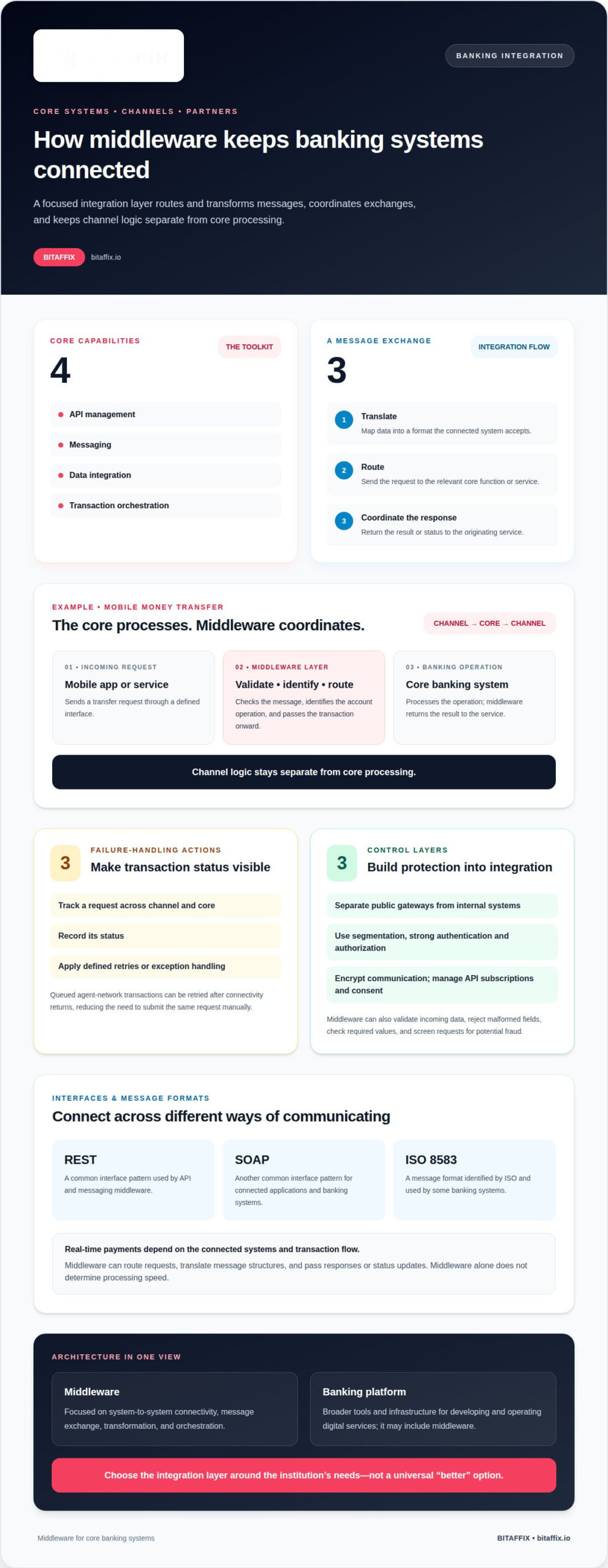
For a mobile money transfer, middleware may validate the incoming message, identify the required account operation and pass the transaction to the core. The core processes the banking operation; middleware coordinates the exchange and returns the result to the originating service. This keeps channel logic separate from core processing.
A banking platform can provide tools and infrastructure for developing and operating digital services, and may include middleware for connectivity. Middleware has a narrower role: it handles communication and integration between systems, including a platform and the core.
APIs, Messaging, and Real-Time Payments
API and messaging middleware exposes controlled interfaces, transforms messages and coordinates exchanges between applications, microservices and banking systems. REST and SOAP are common interface patterns, while the International Organization for Standardization (ISO) identifies ISO 8583 as a message format used by some banking systems.
For payment flows, middleware can route a request, translate its structure and pass responses or status updates between the channel and core. This supports real-time payment processing when the connected systems and transaction flow allow it. Middleware alone does not determine processing speed.
Leading solutions differ in API controls, protocol support, transformation options, transaction handling and scaling design. Compare them against expected workloads, integration complexity, latency needs and the ability to handle growth without disrupting connected services.
Core banking middleware capabilities include API management, messaging, data integration and transaction orchestration. Banks combine them according to whether they need to manage API access, exchange messages, map data or coordinate operations across systems.
Transaction management also addresses failures between connected services. Middleware can track a request across the channel and core, record its status, and apply defined retry or exception handling when a response fails or arrives late. For an agent network, queued transactions can be retried after connectivity returns, reducing the need to submit the same request manually.
Is Middleware still relavant?
Yes. Middleware remains relevant when a bank needs consistent security, resilience and governance across its core, applications and external partners.
For legacy integrations, the main risks include incompatible data formats, unauthorized access, failed transactions and inconsistent controls across connected systems.
Security, Resilience, and Compliance
Security and resilience services apply consistent controls to messages and connections across the integration architecture. They matter because a fintech application or partner connection could otherwise create a route into sensitive banking functions.
API security starts with separating public-facing gateways from internal systems. Network segmentation, strong authentication and authorization, encrypted communication, API subscriptions and consent management help control which applications can access particular functions. Authentication technologies can help verify users of APIs.
Middleware can validate incoming data before it reaches the core. For example, it can reject malformed fields, check required values and screen requests for potential fraud. PCI-DSS is a security requirement to consider when designing banking middleware connections. Its relevance depends on the systems and data involved.
Resilience requires deliberate failure handling. Architecture teams can plan active-active or active-passive failover, disaster recovery sites and load-balanced transaction handling. These measures address different failure scenarios, so the design should define how systems detect disruption, continue processing and restore normal service.
Legacy Integration Risks and Challenges
Legacy integration risks arise when middleware must reconcile older core interfaces with modern applications, partner services and security controls. Addressing these risks matters because a mapping or access error can affect transaction accuracy, service availability or the confidentiality of banking data.
Data transformation is one challenge. A modern API may send JSON, while a legacy core expects a different structure or protocol. Incorrect field mapping can send incomplete or misinterpreted instructions. Clear validation rules, controlled transformations and transaction logging help teams identify where an exchange failed.
Access paths need equal discipline. External partner endpoints can use mutual TLS authentication and remain accessible only through a VPN tunnel between data centres. Middleware can also isolate partner information at the API layer, preventing one partner from querying or acting on another partner’s resources.
Compatibility is only part of the risk. Middleware can introduce latency, and large data volumes can increase performance overhead. Teams should examine transaction paths, exception handling, failover behaviour and monitoring together. This helps reveal whether delays originate in the core, middleware or a connected application.
For banks assessing middleware for core banking systems, a structured architecture review can clarify security boundaries, failure paths and legacy dependencies. Discuss the integration architecture to explore those considerations in context.
Middleware as an abstraction layer
Middleware in a core banking system is an intermediary layer that standardizes how the core exchanges information with digital services. It can shield applications from core-specific interfaces, coordinate data access and provide reusable services across the banking ecosystem.
Banks use this abstraction to separate changeable channels from foundational banking infrastructure. A mobile app, fintech service and branch application can request account information through consistent interfaces, while middleware maps each request to the appropriate legacy system operation.
This separation does not remove the core’s role. The core remains responsible for its banking functions, while middleware manages how external systems reach them. That boundary can make integrations easier to evolve, but it also means banks must govern the intermediary’s interfaces, mappings and dependencies.
API layers make the boundary explicit. An API gateway can publish defined operations, manage access and provide a consistent entry point for applications. Behind it, middleware can connect those calls to different core services, translate data structures and reuse connections across multiple use cases.
For example, an account information API can serve both a mobile app and an approved partner application. Each caller uses the same defined operation, even if the core requires a different internal request. Banks can organize API capabilities around functions such as customer information, accounts, transfers and loans.
Some banks expose over 100 APIs to decouple critical operations from their core banking systems. A catalogue or developer portal can help internal teams find documentation, test APIs, review version history and understand access controls. External partner portals can also present API documentation, compliance requirements, sample payloads and access request processes.
Measure performance across the full request path, not only within middleware. Track transaction latency, error rates, successful completion, retries and service availability, then distinguish middleware delays from core or application delays. Reliability reviews should also examine failed dependencies, recovery behaviour and whether repeated requests cause duplicate processing.
Assess return on investment by comparing the integration’s operating effort and outcomes with its costs. Relevant measures include time spent maintaining separate connections, manual exception handling, repeated integration work and the ability to reuse an API for another application. The value depends on which processes the abstraction improves and how consistently teams adopt it.
Middleware supports a more modular architecture, but adds another layer to operate and govern. Its performance and value therefore depend on clear ownership, disciplined API lifecycle management and observable transaction paths. These practices help banks decide where abstraction simplifies infrastructure and where it adds avoidable complexity.
Core banking modernization without replacement
Modernization does not always require replacing the core. Financial institutions can use middleware to connect existing banking systems with modern platforms, preserving established transaction processing while adding new services around it. This approach can matter for institutions whose legacy architectures were designed nearly four decades ago but still support essential banking operations.
Middleware creates a controlled path between the core and external applications. For example, a bank can introduce a digital account service while keeping account records and transaction processing on its existing core. The integration layer handles communication between systems, allowing modernization work to proceed without making every change inside the legacy environment.
Selecting and implementing middleware starts with priority customer or operational journeys. Institutions then define reusable connectivity and data layers, assess security, resilience, compliance and commercial requirements, and choose an architecture that fits those needs. Implementation can begin by integrating and testing a specific service, monitoring its behaviour, then extending the pattern to other applications.
That sequence keeps the program strategic. A bank might first address a journey that depends on an external service, then use the resulting connection as a foundation for related functions. Reusable interfaces reduce duplicated integration work, while a defined scope helps teams distinguish core changes from middleware configuration and application changes.
Middleware also gives institutions room to add products and test innovations without disrupting core systems. A new customer-facing application can use a defined interface while the core continues to perform its existing functions. If testing reveals a mapping or workflow issue, teams can refine the integration boundary before expanding the service to more users or operations.
Modernization may also involve database middleware. ODBC and JDBC are examples of database connectivity approaches, while Informatica is an example of database middleware. These options serve different integration needs; the relevant choice depends on the systems involved, the data being exchanged and the required operational controls.
Monitoring makes the modernization path manageable. Teams can follow transaction status, integration errors, response delays and recovery behaviour across the middleware and core. For instance, a failed external application request should be traceable to the component that rejected, transformed or processed it. This visibility supports controlled troubleshooting without treating every issue as a reason to replace the core.
The objective is not to preserve every legacy component indefinitely. It is to establish a practical route for change: retain core functions that continue to serve the institution, connect them to modern services through governed interfaces, and use operational evidence to guide the next phase. This lets modernization advance in deliberate increments while the core remains in service.
Middleware versus platform solution scope and functionality
Middleware and banking platforms solve related but different problems. Middleware focuses on system-to-system integration, connecting a core banking system with applications, partners and other services. A banking platform provides broader tools, services and infrastructure for developing, deploying, managing and scaling digital banking applications.
The distinction is one of scope. For example, middleware can translate a payment request between a mobile application and a core interface. A platform can provide the broader environment for operating that application, including services that support its development and management. The integration layer enables communication; the platform supports delivery of digital banking capabilities.
Financial institutions can use middleware when the central requirement is controlled connectivity across existing systems. It can standardize how channels access core functions and reduce the need to build each connection independently. A platform is more relevant when the goal is to create and operate digital services, rather than connect a particular system pair.
- Choose middleware when an application needs a defined connection to a core, partner or other system.
- Choose a platform when teams need tools and infrastructure to develop, deploy and manage digital banking services.
- Use both when a platform’s applications must communicate with core banking functions through governed integrations.
These choices are not mutually exclusive. A banking platform may include built-in middleware, allowing its services to connect with core systems. In that arrangement, the platform supplies the broader operating environment, while its integration capabilities handle communication between applications and the core.
Assess the required outcomes before selecting an architectural layer. If the priority is exposing account or transfer functions to an existing app, integration capability may be central. If the institution needs to build and manage a broader set of digital services, platform scope may carry more weight. Where both needs apply, evaluate how the platform’s built-in connectivity handles the required core interfaces.
Also distinguish product breadth from integration depth. A platform may cover a wide range of digital banking activities, while a middleware layer may address specific protocols, transformations and transaction paths. For example, a new partner connection may need careful mapping to core data even when the bank already operates a digital platform.
The practical takeaway is to match the architecture to the work: middleware connects systems; a banking platform enables the development and operation of digital services. Financial institutions can use either or both, depending on whether the immediate gap concerns integration, service delivery or both.
Middleware is a lower-level technical solution focused on broad system-to-system integration, while platform banking solutions are higher-level and business-oriented. Banks commonly use API management platforms to control API access, rate limits, versioning and analytics.
BitAffix: Banking Sector Solutions
BitAffix provides Banking Sector Solutions and middleware for institutions connecting banking systems with digital services. Turn to its middleware integration solutions when integration needs call for a defined connection layer between systems. This is a practical next step when modernization priorities involve interoperability rather than replacing the core.
Where connected processes also need coordination, BitAffix offers Workflow Automation and Kanban Task Automation. These offerings can support a broader operational approach alongside banking middleware, connecting system integration needs with process and task management.
Contact BitAffix to discuss your banking integration requirements.
Set the Next Integration Priorities
Make the next step an architecture decision, not a technology purchase. Identify the customer or operational journeys that matter most, assign ownership for each integration boundary, and define how teams will assess performance and control access. This connects decisions about middleware for core banking systems to institutional priorities.
BitAffix supports banking requirements through Banking Sector Solutions and Middleware. Its Workflow Automation, Kanban Task Automation and Secure Document Archiving offerings can also support related operational processes where they fit the need. Define the banking outcome first, then determine which capabilities support it.
Bring technology, operations and risk stakeholders into the discussion early. Shared ownership helps align integration choices with service needs, governance and day-to-day processes. A deliberate starting point gives your teams a stronger basis for sequencing modernization and adapting the architecture as priorities evolve.
Move forward with a clear mandate and a practical path to connected banking operations.
Frequently Asked Questions
What Happens Without Middleware?
Without middleware, each application may need its own direct connection to the core or another banking system. For example, a mobile channel and a partner service could require separate mappings, access controls and error handling. This increases integration dependencies and makes changes harder to coordinate. Some services can exchange data through other established interfaces, but teams still need to manage compatibility, security and transaction handling across those connections.
Which middleware platforms integrate with popular core banking systems?
Integration depends on the core system, its version, exposed interfaces and the middleware’s available connectors. Rather than assume a platform supports every core, assess whether it can handle the required APIs, message formats, data mappings and transaction flows. A practical evaluation uses a representative use case, such as retrieving account details, then tests the complete request and response path with the institution’s core configuration.
What are typical costs and licensing models for core banking middleware?
Licensing may use subscription, perpetual, usage-based or bundled models, while implementation effort depends on interfaces, data transformations, environments and support needs. There is no single typical cost for banking integrations. For a specific service, the price depends on the case and is provided after a quote request; relevant cost factors include integration scope, deployment requirements and ongoing operational needs.
What security, compliance, and data residency requirements apply to banking middleware in the UAE?
UAE banking projects should map applicable regulatory and institutional requirements to each data flow and deployment environment. Document where data is processed and stored, who can access it, how connections are protected, and how activity is recorded. The institution’s regulator, data classification, contractual commitments and connected partners shape the required controls. Security design should also address authentication, encryption, access segregation, incident handling and audit evidence.
How do leading core banking middleware solutions compare on features, performance, and scalability?
Leading solutions differ in API controls, protocol support, data transformation, transaction handling and scaling design. Compare them against expected workloads, integration complexity, latency needs and their ability to handle growth without disrupting connected services.