
Power plant efficiency depends on how well operational data informs each decision. Energy sector process automation connects plant systems and workflows so teams can monitor operations, coordinate responses, and manage energy use across different plant types.
Reliable control, lifecycle support, and cost discipline all matter in the UAE’s energy sector. Automation can support these priorities by helping teams organize information, reduce repetitive work, and make process performance easier to oversee. Its role depends on the plant’s systems, operational goals, and integration requirements.
This article explains how distributed control systems support power plant operations, where automation fits across the asset lifecycle, and how process optimization can improve energy management. It also covers implementation considerations to help decision-makers see where automation can support plant-wide governance and where a focused workflow improvement may be the practical next step.
Key Takeaways
- Understand how distributed control systems coordinate plant processes and support consistent operational oversight.
- Map automation opportunities across the asset lifecycle, from performance monitoring to maintenance workflows.
- Identify where process automation can reduce repetitive work and help improve operational efficiency.
- See how automation priorities differ across conventional, solar, and wind power plants.
- Learn how connected operational data can support energy management, load balancing, and process optimization.
Distributed control systems for power plants
Distributed control systems coordinate plant processes through connected control points and operator interfaces. In the UAE, integrating them with operational and business systems can help teams manage generation, carbon data, and storage processes coherently.
Control System Integration
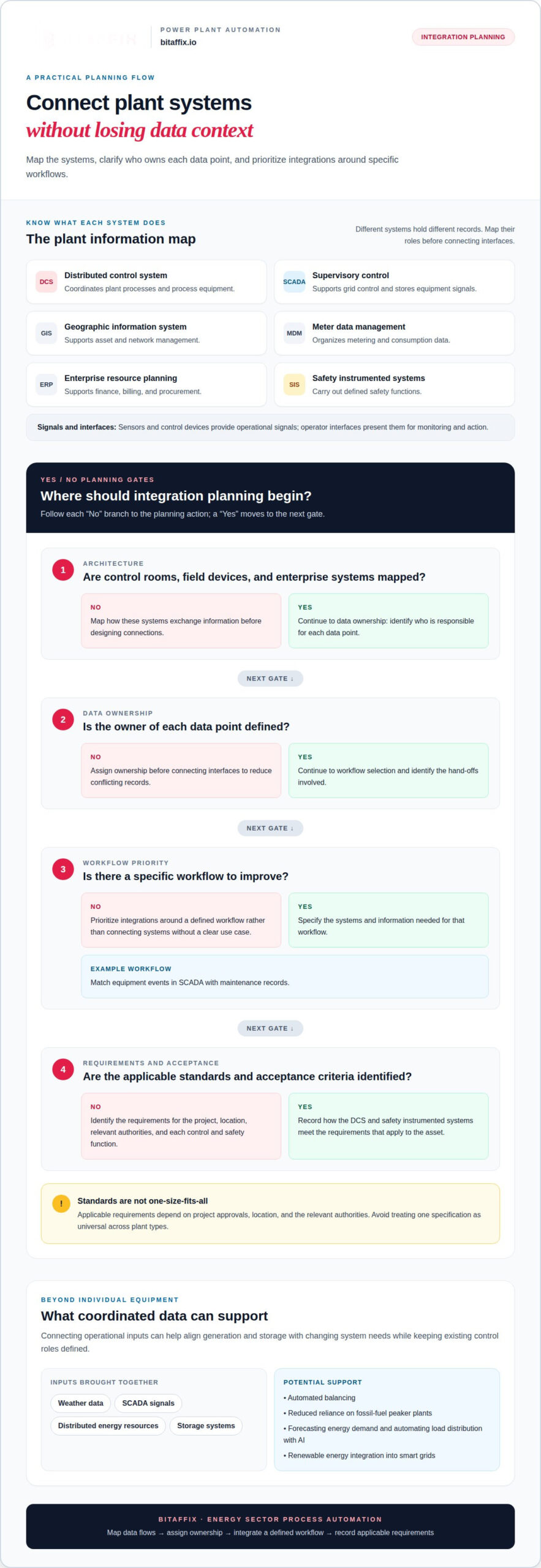
For UAE power plants, integration starts with mapping how control rooms, field devices, and enterprise systems exchange information. A distributed control system can coordinate process equipment, while SCADA supports grid control and GIS supports asset and network management. MDM organizes metering and consumption data; ERP supports finance, billing, and procurement. Define which system owns each data point before connecting interfaces. This reduces conflicting records and gives operators a clearer view of plant activity.
Legacy IT and OT Fragmentation
Legacy IT and operational technology often have different functions and data structures. For example, a plant may store equipment signals in SCADA, network assets in GIS, meter records in MDM, and purchasing data in ERP. These divisions complicate reporting when teams transfer information manually. Map the systems, data owners, and hand-offs first. Then prioritize integrations around specific workflows, such as matching equipment events with maintenance records. This preserves established control processes while improving information flow.
Regulations and Standards
For a UAE plant, applicable requirements depend on project approvals, location, and the relevant authorities. Identify the governing standards and acceptance criteria for each control and safety function during project planning. Avoid treating one specification as universal across all plant types. Record how the distributed control system and safety instrumented systems meet the requirements that apply to the asset. This gives engineering, operations, and governance teams a shared basis for design review and commissioning.
Automation Technologies
Core technologies include distributed control systems for plant processes, SCADA for grid control, and safety instrumented systems for defined safety functions. Sensors and control devices provide operational signals, while operator interfaces present them for monitoring and action. Integration layers connect these operational systems with tools such as ERP, GIS, and MDM. For UAE operators, energy sector process automation depends on choosing interfaces that preserve data context across systems. A practical sequence is to map data flows, assign ownership, and then integrate workflows with clear audit records.
Operational coordination can also bring together weather data, SCADA signals, distributed energy resources, and storage systems. Integrating these inputs can support automated balancing and reduce reliance on fossil-fuel peaker plants. AI systems can forecast energy demand, automate load distribution, and help integrate renewable energy into smart grids. These capabilities extend control design beyond individual plant equipment: coordinated signals can help align generation and storage with changing system needs while preserving the defined roles of existing control systems.
One exajoule is equivalent to the yearly production of 47 660-MW power plants, providing a scale comparison for energy output. A food processing plant reduced pump energy consumption by 47% after installing VFDs with appropriate control algorithms. At an IGCC plant in Priolo, Italy, advanced process control reduced acid gas removal section steam consumption from 35.1 t/h to 26.1 t/h. These examples illustrate how control strategies can improve resource use when suited to process requirements.
Automation services and lifecycle support
Energy companies plan and implement process automation by defining operational goals, mapping systems and workflows, then prioritizing integrations. They can introduce changes in controlled stages, measure process performance, and refine workflows as electricity operations evolve.
Lifecycle support extends beyond initial deployment. During design, teams document data sources, process owners, and hand-offs. During implementation, they configure workflows and connect relevant systems. After launch, they monitor exceptions, maintain records, and adjust processes as equipment, reporting needs, or operating priorities change. For example, equipment performance data can support failure forecasts and help teams plan maintenance before a disruption occurs.
Customer service and billing workflows offer another practical application. An intelligent assistant can handle routine billing inquiries, outage reports, and energy-use questions. Automated checks can also identify billing anomalies and notify utility customers. Define which requests the workflow can resolve, which need staff review, and how each case moves between channels. This keeps customer records connected to the action taken and reduces repeated manual entry.
Energy industry services can also coordinate operational, asset, and enterprise information. Integrated workflows that bring together ERP, asset management, and operational systems can support emissions reporting across Scope 1, 2, and 3, with audit trails. Emissions monitoring data can feed automated environmental reports. Clear ownership for each data field helps teams trace how a reported value moves from source system to final record.
Cybersecurity must be part of the automation lifecycle, not a later add-on. For each workflow, document which users and systems can access data, what information moves between them, and how activity is recorded. Separate operational control functions from business workflows where the design calls for it. Establish an escalation path for access issues and unexpected system behaviour. These steps make governance visible as automation expands.
A practical implementation sequence keeps the transition manageable:
- Set an operational objective: Choose a defined workflow, such as equipment maintenance reporting or billing inquiry handling.
- Map inputs and decisions: Identify the source data, process owner, exceptions, and required approvals.
- Integrate and test: Connect the necessary systems, then test normal cases and exceptions before release.
- Review performance: Track unresolved cases, data quality, and audit records, then refine the workflow.
For energy teams shaping an automation roadmap, a process planning discussion can help structure priorities around workflows, system connections, and governance.
Utility automation can involve several distinct information systems. Energy companies commonly use SCADA for grid control, GIS for asset and network management, MDM for metering and consumption data, and ERP systems for finance, billing, and procurement. These systems handle information about grid control, network assets, metering, finance, and procurement that automation services may need to accommodate.
Environmental and industrial workflows can also draw on multiple data types. The industrial sector consumes approximately one-third of the world’s energy. Motors consume approximately 70% of industrial electricity. AI can process satellite imagery, sensor data, and emissions reports to support environmental compliance monitoring. Integrating weather data, SCADA signals, distributed energy resources and storage systems can support automated balancing and reduce reliance on fossil-fuel peaker plants.
Operational efficiency and cost reduction
Automation can improve efficiency by linking operational signals to timely decisions and repeatable actions. In energy operations, iPaaS can connect systems while AI analyses data to support more precise utilization.
Process Automation and Digitalization
Digitalization makes operational information available in structured digital form. Process automation uses that information to execute defined steps, such as routing an equipment alert into a maintenance workflow. AI adds analysis: it can detect patterns, forecast demand, or identify vibration anomalies in wind turbines. These capabilities work together but solve different problems. Before selecting a solution, define whether the priority is better data access, consistent execution, or predictive insight.
For example, an integration platform can bring together data from operational systems, asset management, and enterprise applications. Hybrid-ready platforms can execute close to data on-premises or at the edge while maintaining centralized governance. An iPaaS approach helps coordinate these connections and workflows; middleware integration solutions can support system interoperability. Clear data ownership and access controls help keep information consistent as it moves between systems.
AI can also inform real-time operational choices. Demand forecasts can help grid teams adjust operations to manage peak loads and reduce outage risk. For wind assets, algorithms can flag unusual vibration patterns for maintenance review. These outputs support decisions; the operating team still defines which actions require approval and which workflows can proceed automatically.
Benefits and Challenges
The benefits include fewer repetitive tasks, clearer asset information, and more targeted energy use. Industrial facilities can reduce energy consumption by 10-30% through systematic efficiency improvements. Variable frequency drives illustrate how control strategy affects results: a 20% reduction in motor speed can yield approximately 50% energy savings. Actual value depends on the equipment and operating conditions, so teams should evaluate each application against its process requirements.
Integration complexity remains a practical challenge. Different systems may use distinct data formats, access rules, and update cycles. Unclear ownership can create conflicting records, while excessive automation can route exceptions incorrectly. Map data sources, identify process owners, and test exception paths before expanding deployment. Transparent, auditable workflows also help maintain governance as automation scales.
A disciplined efficiency review can focus on four operational checks:
- Prioritize a process: Select a recurring task, such as alert triage or energy reporting.
- Establish a baseline: Record current energy use, process delays, and manual hand-offs.
- Define controls: Specify approvals, exception handling, and access permissions.
- Review outcomes: Compare utilization, emissions data, and workflow completion after changes.
Automation for different power plant types
Automation varies by asset: oil and gas operations coordinate process equipment, power plants manage generation, and utilities balance supply with demand. In the UAE, align each automation workflow with the plant’s technology, operating priorities, and renewable energy mix.
Oil and Gas Automation
Oil and gas automation connects operational signals with defined control and response workflows. For example, operators can use sensor data to monitor equipment conditions and route an alert to the responsible team. The system’s value depends on the quality and context of those signals. Map which assets produce each data point, who reviews exceptions, and how maintenance actions are recorded.
For a processing facility, start by identifying critical process stages and their information flows. Teams can then prioritize a workflow such as routing equipment alerts, recording inspection findings, or consolidating operational reports. Clear escalation paths distinguish routine notifications from events that need operator attention. This structure supports consistent oversight without treating every facility or asset as identical.
Power Generation Automation
Power generation automation coordinates plant processes and helps operators respond to changing equipment or output conditions. At a wind farm, AI can analyse turbine vibration data and flag anomalies for maintenance review. Solar operators can combine weather data with historical performance to forecast generation. Those forecasts can inform battery storage decisions and help align available output with operating plans.
Conventional plants also benefit from connected operating data. Teams can use automation to organize process information, route operational events, and support emissions reporting. The design should distinguish tasks suitable for automated handling from decisions that require operator review. This preserves accountability while enabling consistent workflows across plants with different equipment and operating profiles.
Utilities coordinate a broader system view. AI can analyse sensor readings, smart-meter information, weather forecasts, and market trends to inform load balancing and asset management. During heatwaves, demand forecasts can help utilities plan distribution proactively. Real-time generation and consumption data can also support electricity rerouting. Integration with renewable sources and storage gives operators more information to balance supply as conditions change.
Across UAE energy operations, implementation should begin with an asset and workflow map. Identify data sources, process owners, exception routes, and the systems that need to exchange information. Then select an operational use case, such as turbine anomaly review or solar output forecasting, and define how teams will act on its results. This staged approach connects automation to plant needs rather than applying one design to every asset.
Energy management and process optimization
Energy management improves when plants connect operational decisions to current supply and demand conditions. For UAE energy operators, a practical priority is coordinating conventional generation, renewable sources, and storage using consistent data.
According to the World Economic Forum, future energy systems depend on how effectively data moves between physical assets. This principle shapes process optimization: a solar farm, battery system, and grid operator need timely information to coordinate output. AI can analyse sensor readings, smart-meter data, weather forecasts, and market trends to inform distribution, load balancing, and asset management. The value comes from linking useful data to a defined operating decision, not collecting signals without a purpose.
Forecasting helps teams plan for changing conditions. AI can combine weather information with historical performance to estimate solar and wind generation. Operators can use forecasts to adjust battery storage to expected solar output, then align available supply with grid requirements. Utilities can also anticipate residential demand spikes during heatwaves and plan load distribution proactively. For each use case, define the forecast owner, update cycle, and action that follows a material change.
Optimization also requires a shared view of performance. Teams can connect energy data with asset and operational records, then compare expected output with observed conditions. For example, a wind facility can use turbine performance trends to identify assets that need closer review. Clear data definitions help operators distinguish a genuine process deviation from inconsistent readings. This strengthens the basis for maintenance and dispatch decisions without replacing operational accountability.
Renewable integration introduces variability in generation and supply. Automated balancing can combine weather data, operational signals, distributed energy resources, and storage information. This connected view helps coordinate available sources as conditions shift. Define how the system prioritizes inputs, handles missing or conflicting data, and records decisions. Transparent, auditable workflows make it easier to understand why a balancing action occurred and how it affected plant operations.
A disciplined optimization cycle keeps these capabilities focused:
- Choose an outcome: Define whether the priority is demand forecasting, storage coordination, or asset utilization.
- Connect relevant sources: Identify the sensors, meters, weather feeds, and operational records needed for that decision.
- Set decision rules: Assign owners, thresholds, exception routes, and approval points for automated actions.
- Review performance: Compare forecasts with actual generation and document adjustments to the process.
This approach makes energy management a continuous operating discipline. Connected sources inform decisions, while clear rules keep optimization accountable.
BitAffix: Energy Sector Solutions
BitAffix helps energy organizations structure operational workflows through its Energy Sector Solutions. Turn to this offering when teams need clearer processes for coordinating energy-sector work, rather than changes to plant control hardware. Workflow Automation can organize repeatable approvals and hand-offs, while Kanban Task Automation helps teams track tasks and their status. Secure Document Archiving supports orderly access to operational documents and records.
Start by identifying a workflow that crosses teams or depends on manual follow-up. Define its owners, approvals, records, and exceptions, then determine how automation can support it. This gives decision-makers a practical scope for discussing operational needs and priorities.
Contact BitAffix to discuss your energy-sector workflow priorities.
Build the Next Stage of Plant Automation
Power plant automation is an ongoing operational decision, not a one-time technology choice. As generation portfolios and business priorities change, teams need a roadmap that can adapt without losing clear ownership or governance.
For UAE operators, the next step is aligning automation priorities with the organization’s direction. Set decision rights, define how teams will review changes, and connect operational goals to the broader energy management strategy. This creates a basis for scaling initiatives in a controlled way.
Use energy sector process automation to strengthen the operating model as well as individual workflows. A clear roadmap helps leaders sequence future initiatives, keep accountability visible, and connect technology decisions to long-term priorities. Start with one defined objective, then expand as teams establish the right governance and operational alignment.
Move forward with a considered plan and a clear view of what the next stage should achieve.
Take the next step with confidence and build a more coordinated path for your energy operations.
Frequently Asked Questions
What is process automation in the energy sector?
Process automation uses technology to carry out defined operational tasks consistently, based on data and preset rules. In an energy organization, it can route an inspection record for approval, assign a maintenance request to a team, or flag an exception for review. Automation executes a governed workflow; operators retain responsibility for decisions that require operational judgment.
What is the ROI and payback period for energy automation projects?
ROI depends on the project’s implementation and operating costs, the process baseline, and measurable benefits such as reduced manual effort or energy use. Variable frequency drive implementations often achieve payback in 6-24 months. For a project assessment, establish the baseline first, then track the same operational measures after deployment. Include integration, maintenance, training, and ongoing governance in the calculation to avoid overstating returns.
What cybersecurity risks affect automated energy systems?
Automated energy systems can face unauthorized access, compromised credentials, misconfigured permissions, and interruptions to connected systems. Data integrity matters too: altered or incomplete readings can lead teams to act on inaccurate operational information. Reduce exposure by limiting access to approved roles, recording system activity, reviewing integration permissions, and defining how teams respond to unusual access or data changes. Include operational and enterprise connections in that review.