
AI creates the most value in banking when it improves a defined process, not when it operates as a standalone experiment. A strong Banking Use Case connects automation to a practical outcome, such as faster document review, more consistent fraud monitoring or more relevant customer support. Banks can apply AI across customer operations, risk, lending and back-office workflows while keeping governance and human oversight in view.
Efficiency matters, but it is only part of the decision. Banking leaders also need to understand how automation can support revenue generation, improve decision-making and create economic value without adding operational complexity.
This article explores practical banking applications across key functions, from fraud detection and onboarding to credit assessment and transaction processing. It also explains how banks can prioritize opportunities, connect workflows and preserve appropriate human review. The aim is to clarify where AI can improve banking operations and how to assess its fit for the UAE market.
Key Takeaways
- Prioritize automation by linking each candidate process to a clear operational or revenue outcome.
- Compare banking case studies by the task improved, the workflow involved and the result achieved, not by headline figures alone.
- Apply AI across fraud monitoring, customer support, lending, onboarding and back-office operations where it can support faster, more consistent decisions.
- Preserve human review and governance so teams can oversee automated outputs and manage operational risk.
- Connect workflow automation, task management and secure document archiving to reduce friction across banking processes.
1. Operational efficiency and revenue generation
Generative AI moved banking forward in 2023-2024, shifting experimentation toward practical enterprise operations. More than 80% of banks are forecast to have adopted generative AI by 2026. The opportunity spans transaction processing, lending, customer engagement and financial analysis. Institutions can reduce repetitive work while helping teams focus on decisions that affect service quality and revenue.
The UAE has a strong foundation for this transition. According to the Microsoft AI Economy Institute’s Q2 2026 research, generative AI usage reached 73.3% among the working-age population. For banks, that adoption makes digital customer journeys increasingly familiar. A banking use case should still start with a defined process, such as reviewing applications or routing service requests, rather than deploying models without an operational goal.
Lending shows how targeted automation can improve efficiency and support decision-making. AI systems can extract application data, verify financial records, flag potential risk indicators and prepare preliminary credit assessments. Staff can then focus on exceptions and complex cases. This gives credit teams a more structured view of each application without treating an automated assessment as the final lending decision.
Digital banking can improve customer experience by reducing repeated data entry, simplifying routine interactions and tailoring responses to each request. For example, AI assistants can interpret questions in natural language and retrieve information from internal knowledge bases. Customers get more direct support, while relationship managers can focus on complex financial needs that call for human judgment.
AI can also connect service interactions to revenue opportunities. Banks can analyze customer data to tailor financial insights and recommend products aligned with customers’ behavior or goals. PwC Strategy& analysis predicts that data-driven insights could increase lead conversion rates by up to 30%. Banks can use that signal to prioritize relevant follow-up, while keeping recommendations grounded in customer context.
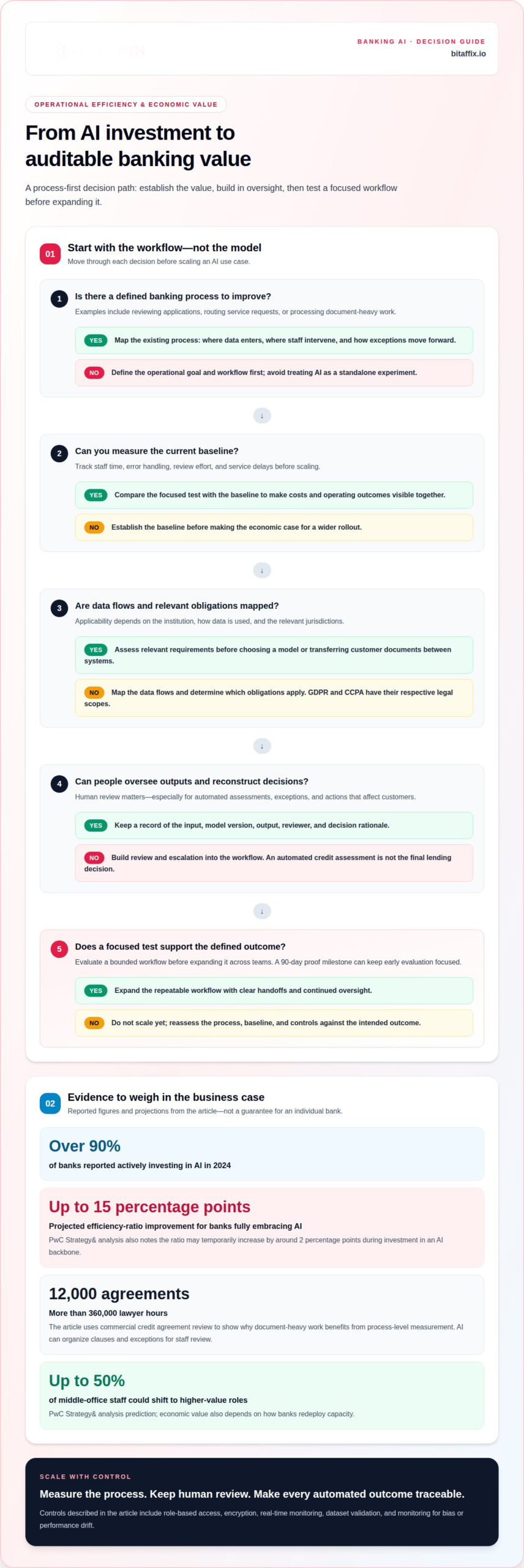
Scaling these gains requires operational maturity, not just a capable model. Organizations with the highest operations maturity are 3.3 times more likely to succeed at scaling high-value AI use cases. Banks can map the existing process, define a measurable outcome, assign human review points and test a focused workflow before expanding it across teams. A 90-day proof milestone can help keep early evaluation bounded and practical.
Generative AI creates and summarizes content, while agentic AI can coordinate actions across defined steps. For example, an agent can gather application details, route missing information for review and prepare a case summary. Suncoast Credit Union reviewed 10 times more checks with agentic automation. That example highlights throughput potential, while approval rules and escalation paths remain essential controls.
To capture value, connect models to the systems and teams that execute the work. A documented process can show where data enters, where staff intervene and how exceptions move forward. Workflow automation can structure these handoffs across banking operations, helping institutions scale repeatable tasks while retaining clear oversight.
2. Operational efficiency and economic value
AI investment now carries a substantial operating commitment. Over 90% of banks reported actively investing in AI in 2024. That investment can support cost savings, but infrastructure, integration and controls also consume resources. Banks should assess each initiative against a clear baseline, including staff time, error handling, review effort and service delays. This makes the economic case visible before leaders scale a model across operations.
Document-heavy work shows why process-level measurement matters. Reviewing 12,000 commercial credit agreements would have taken lawyers over 360,000 hours. AI can help extract clauses, identify exceptions and organize documents for review. Staff retain authority over interpretation and action, while audit records capture the source document, model output and any human change. This creates a traceable workflow rather than an unexplained automated decision.
Efficiency ratios also show the trade-off between investment and return. PwC Strategy& analysis projects that banks fully embracing AI could improve their efficiency ratio by up to 15 percentage points. During investment in an AI backbone, banks may temporarily see that ratio increase by around 2 percentage points. Leaders should therefore track implementation costs and operating outcomes together, rather than treating early expenditure as evidence of failure.
For UAE banks, applicable requirements depend on the institution, how data is used and the relevant jurisdictions. GDPR and CCPA govern data handling in their respective legal scopes, so they may not apply to every bank or use case. Banks should map data flows and assess relevant obligations before selecting a model or transferring customer documents between systems.
Strong controls make automated operations easier to audit. Banks can limit access with role-based permissions, protect data with encryption and monitor systems in real time. They should validate training datasets, monitor models for bias or performance drift, and retain human review of automated decisions. For each action, record the input, model version, output, reviewer and decision rationale. These records help audit teams reconstruct how an outcome was reached.
Economic value also depends on redeploying capacity. PwC Strategy& analysis predicts that automation could shift up to 50% of middle-office staff to higher-value roles. Banks can identify suitable tasks by separating repeatable document processing from decisions requiring judgment, then measuring whether automation reduces handling effort without weakening review. A structured document archiving process can support retrieval and auditability across records.
To assess an automation initiative, compare its baseline with processing effort, exception rates, review requirements and control evidence. Discuss audit-ready automation priorities when your team is ready to map those measures to an operational workflow.
3. Real-world AI banking case studies
Fraud detection shows how AI can combine transaction intelligence with faster investigation. AI fraud systems reduce false positives by 70% compared with rules-based systems and detect 15% more genuine fraud. AI systems can analyze millions of transactions per second to flag suspicious activity in real time. These examples show the scale of continuous monitoring, where models compare activity patterns and flag anomalies for review. Human investigators still assess alerts and decide what action follows.
Customer experience offers another measurable application. DBS Consumer Banking Group sent 45 million hyper-personalised nudges monthly to over five million customers across the region. These messages can turn customer data into timely prompts, such as a spending insight or a relevant financial reminder. The operational lesson is to connect personalization to a clear customer need, then govern which data informs each interaction.
Onboarding and verification can reduce friction for business customers. One institution reported that AI-driven onboarding and verification tools reduced the cost of verifying commercial banking clients by 40%. NatWest reduced selected business onboarding checks from 15 minutes to under 60 seconds. These examples point to a practical sequence: extract submitted information, validate records, identify missing items and route exceptions to staff. Faster processing should preserve a traceable decision path.
Document review can also shift work from manual reading to focused assessment. Lloyds reduced selected commercial real-estate document reviews from several hours to about five minutes. DBS reported that selected trade finance condition processing was 60% faster. In both cases, AI can organize documents and surface relevant clauses, while specialists handle interpretation and exceptions. This division supports faster operations without removing human accountability.
Credit monitoring illustrates how predictive models can help teams act earlier. DBS reported identifying over 95% of non-performing SME loans at least three months before the businesses experienced credit stress in 2022. DBS also reported that over 80% of identified at-risk borrowers were averted from risk in 2022. Banks can use early warning signals to prioritize outreach, assess changing borrower conditions and document intervention decisions.
These cases are not interchangeable templates. A bank should compare the process, data inputs, exception paths and governance controls behind each result before adapting it. BNY reported that AI-assisted transaction inquiries were handled 80% faster, demonstrating a separate opportunity in servicing. A measured rollout can begin with one workflow, record baseline processing time and review outcomes before expansion. This approach helps institutions connect automation to evidence, customer experience and responsible operating decisions.
4. AI use across banking functions
Fraud and cybercrime detection can use transaction patterns to prioritize investigations. Systems compare transaction size, location, timing and payment frequency with a customer’s usual activity. They can also analyze links across accounts for signs of coordinated fraud or money laundering. Investigators review alerts, consider the surrounding context and decide what action to take. This lets analytics surface unusual activity while keeping decisions accountable.
Customer service can combine virtual assistants with human support. An assistant can interpret a natural-language request, retrieve guidance from an internal knowledge base and answer routine queries. For example, a customer asking about a payment status can get a direct response without navigating several service channels. Banks can route complex requests to human advisors, freeing relationship teams to focus on needs that require judgment.
Marketing and customer targeting use analytics to make interactions more relevant. Models can assess spending patterns and identify financial insights or product recommendations aligned with a customer’s behavior or goals. Banks can link each recommendation to its underlying customer context, then monitor whether it serves a genuine need. This makes personalization more purposeful than sending the same promotion to every account holder.
Credit scoring and risk assessment apply AI to lending decisions. Models can organize financial information and identify indicators for further review. Credit teams assess exceptions, examine the rationale behind outputs and monitor for bias or performance drift. PwC Strategy& analysis predicts that AI could improve proactive risk management by up to 35% compared with traditional methods. Human review remains important for decisions that carry significant consequences.
Treasury teams can use AI to analyze internal financial data and market information for liquidity forecasts, funding strategies and capital allocation. In payments and back-office operations, machine learning can process documents, route information between systems, monitor payment flows and support continuous reconciliation. Teams can set escalation paths for exceptions and retain review records. These controls help staff understand how information moved through each automated workflow.
Regulatory reporting offers another defined application. A Regulatory Filing Assistant can monitor regulatory changes and populate filing templates with validated transactional data for filings such as FATCA, CRS and Basel reports. Staff review source data and prepared figures before submission. A 2025 MIT Technology Review and EY survey of 250 banking executives found that 95% of institutions use AI in an advisory capacity, while 92% use it in an assistive capacity. That model keeps AI in a supporting role while people retain authority over decisions.
More than 50% of significant euro-area banks reported using AI for fraud and cybercrime detection. Approximately 50% reported using it for marketing and customer targeting, and approximately 30% for credit scoring and risk assessment. Banks can also use AI to analyze transaction networks across accounts for patterns that may indicate coordinated fraud or money laundering. In a 2025 MIT and EY survey of 250 executives, 56% said agentic AI was highly capable of improving fraud detection, while 51% said it was highly capable of improving security. Together, these findings show interest in applying AI to both operational detection and broader security challenges.
5. What are common banking use cases for consumers and businesses?
Consumers use digital banking for routine account tasks, payments and financial guidance. A mobile assistant can retrieve transaction details, explain a payment status or direct customers to the right service channel. Spending analysis can group transactions and reveal patterns, helping customers understand where their money goes. Banks can keep the experience useful by presenting relevant information clearly and routing complex requests to staff.
Personalized prompts offer another consumer application. A bank can analyze spending patterns and provide a timely reminder, savings insight or product suggestion aligned with a customer’s goals. DBS Consumer Banking Group’s monthly personalized nudges show how institutions can deliver relevant communications at scale. The key operational step is to link each prompt to an appropriate customer context, rather than send generic messages that add noise.
For businesses, digital onboarding can simplify the movement from application to account setup. AI can extract information from submitted documents, identify missing fields and route exceptions to staff. NatWest reduced selected business onboarding checks from 15 minutes to under 60 seconds. That case illustrates the value of reducing repetitive checks while preserving review for incomplete or inconsistent records.
Small and medium-sized businesses can also use digital banking tools to understand cash flow. Transaction categorization can organize incoming and outgoing payments, while analytics can help business owners review trends and plan upcoming obligations. Bank teams can use the same financial data to tailor relevant insights. The strongest experience connects account activity to a clear next action, such as reviewing a change in spending.
Payment workflows serve consumers and organizations alike. Consumers can make routine transfers through digital channels, while businesses can use account information to reconcile incoming payments against invoices. Open banking can also let customers share financial information with trusted third parties or initiate payments for goods and services. Each flow needs clear consent, accurate transaction details and visible status information so users understand what happened.
Customer support connects these use cases. A virtual assistant can answer routine balance or transaction questions, while a service team handles disputes or complex account needs. Support is more effective when it connects a request with the relevant account or payment context. Banks can map request types, define escalation paths and measure whether digital channels resolve needs without unnecessary handoffs.
For institutions planning connected customer and business workflows, Book a demo
A clear route to the right team makes the next step easier to understand. For organizations, support can address account questions alongside payment workflows, while staff handle complex needs. A clear handoff keeps digital assistance connected to human support.
Open banking payment solutions can help charities and other third-sector organisations reduce card processing fees and create a smoother donation journey. These solutions extend digital payment options beyond routine consumer and business transactions to charitable giving. Clear consent and accurate transaction details can help donors understand the payment they are making, while visible status information shows what happened. For charities and other third-sector organisations, a smoother donation journey can make contributing more straightforward. These payment use cases show how digital banking can support different needs while keeping the transaction process clear for the people and organisations involved.
BitAffix: Banking Sector Solutions
BitAffix provides Banking Sector Solutions for institutions that want to structure and automate operational workflows. These solutions are useful when manual handoffs, dispersed task ownership or difficult document retrieval create friction across banking processes. Workflow Automation coordinates repeatable steps, Kanban Task Automation helps teams track work and progress, and Secure Document Archiving supports organized access to important records.
Start with a defined process, such as routing a document for review or assigning follow-up tasks. Map the handoffs, roles and review points in the current workflow, then identify where automation can improve coordination. This grounds the initiative in operational needs and governance requirements.
Contact BitAffix to discuss banking workflows that could benefit from automation.
Turn a Banking Use Case into an Operational Roadmap
AI creates durable value when a defined banking use case connects a customer or operational need with accountable execution. Select a workflow, document its current handoffs and review points, then agree how the institution will assess outcomes. This gives business, operations and technology teams a shared basis for decisions.
Keep the first initiative focused. Map where information enters, who acts on it and how exceptions reach the right reviewer. Align automation with existing governance and operational priorities before expanding into connected processes. This helps teams make progress with control and build a clear path from process improvement to broader transformation.
Choose a workflow that matters to your institution, define how success will be assessed and bring the right stakeholders together to plan the next stage.
A disciplined starting point can turn AI ambition into practical progress for UAE banking operations.
Frequently Asked Questions
What banking use cases are enabled by AI and automation?
AI and automation can support fraud monitoring, customer service, onboarding, lending assessment, document processing, reconciliation and treasury analysis. Consider a disputed card payment: automation can collect transaction details, classify the request, route it to the right queue and retain the case history. Staff examine unusual evidence and decide the outcome, keeping the case traceable and accountable.
What are the costs and ROI of implementing banking technology use cases?
Implementation costs depend on integration scope, data preparation, governance controls, staff training and workflow complexity. Assess return on investment by comparing baseline and post-deployment measures, such as processing effort, rework, exception volumes and time spent on manual tasks. Include ongoing model oversight and system maintenance in the evaluation. This gives decision-makers a fuller picture of operational value alongside implementation and operating costs.