
A secure DMS letter workflow for financial institutions turns correspondence into controlled, traceable records. It captures and classifies letters, routes them for review and approval, controls access, and preserves approved versions for retrieval and archiving. Each action is tied to the document’s lifecycle, helping teams manage correspondence consistently.
Control matters as much as digitization. A searchable repository speeds retrieval, while approval steps and secure archiving help show who handled a letter, what changed, and which version was finalized.
This guide explains what a banking document management system does and how its workflow operates, from capture through retention. You’ll see how classification, routing, permissions, audit trails, and archiving work together to support compliance and audit readiness in the UAE. It also explains when structured workflows can reduce manual handling and how BitAffix’s banking sector solutions, workflow automation, and secure document archiving can support implementation.
Key Takeaways
- Map how letters move from capture and classification through review, delivery, retrieval, and archiving to expose manual handoffs.
- Use automated routing and controlled templates to standardize correspondence while keeping review steps visible.
- Connect retention rules, version history, and audit trails so records remain traceable throughout their lifecycle.
- Apply role-based permissions to limit access to sensitive letters and support accountable handling across teams.
- Bring approval workflows and secure archiving together to strengthen governance without losing operational flow.
Automated document workflows
A document management system coordinates letters from creation through delivery and retention. For financial services teams, automation standardizes recurring tasks while keeping each document under control.
Automating Document Preparation and Distribution
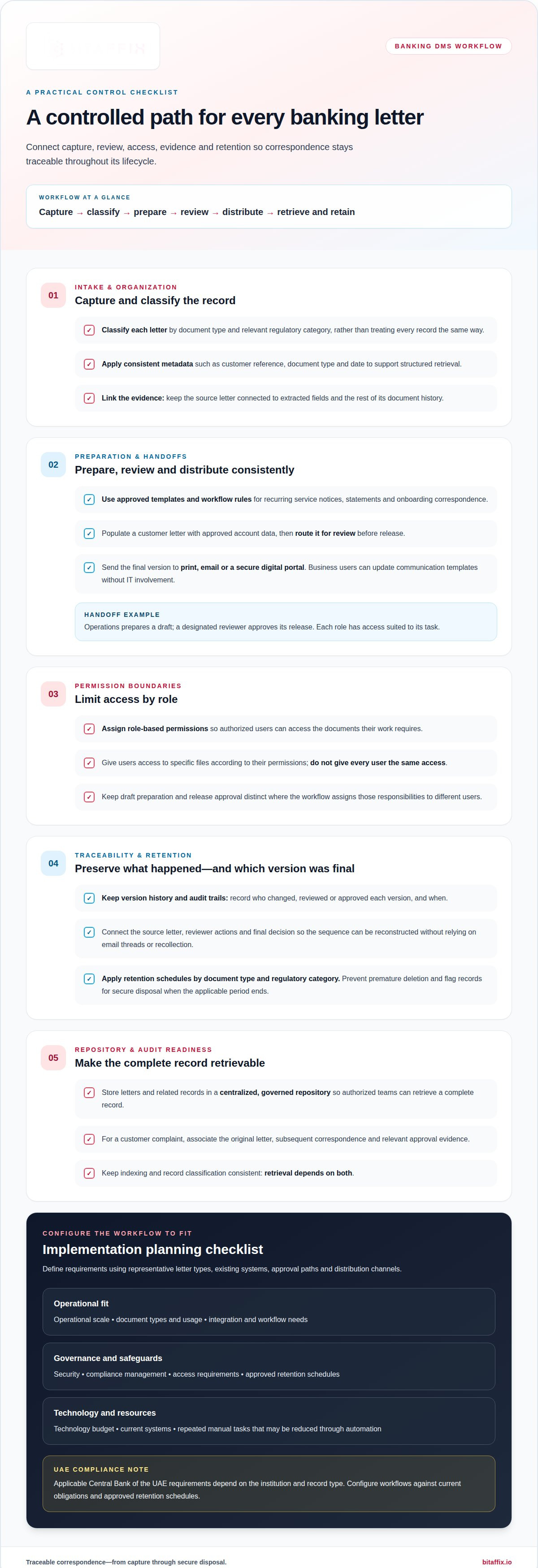
Automation uses approved templates and workflow rules to prepare, review, and distribute routine letters. This lets staff handle service notices, statements, and onboarding correspondence through consistent processes.
For example, a workflow can populate a customer letter with approved account data, route it for review, then send the final version to print, email, or a secure digital portal. Business users can update communication templates without IT involvement, reducing reliance on technical teams for routine document changes. Clear routing also helps prevent manual handoffs from delaying distribution.
Tracking Compliance Across the Document Lifecycle
Lifecycle tracking records a document’s status and handling from creation to secure disposal. This helps financial institutions retrieve correspondence and show how teams reviewed or updated it.
A document management system can link the source letter, extracted fields, reviewer actions, and final decision as evidence. It can also apply retention schedules by document type and regulatory category, helping prevent premature deletion and flagging records for secure disposal when the applicable period ends. These controls support audit preparation without treating every letter as the same kind of record.
For UAE institutions, applicable Central Bank of the UAE requirements depend on the institution and record type. Configure workflows against current obligations and approved retention schedules, recording each record category, retention trigger, approval, and disposal action.
Securing Document Exchange Across Organizational Levels
Secure exchange gives authorized users access to the documents their roles require. This matters when a customer letter passes between operations, compliance, and a branch before release.
A multi-tier digital vault can assign distinct permissions and features to organizational roles. A document management system can share files with specific users according to those permissions, while access controls prevent unauthorized viewing. For example, an operations team may prepare a draft while a designated reviewer approves its release. This keeps the exchange structured without giving every user the same access.
Selection and implementation should account for operational scale, document types and usage, integration and workflow needs, security, compliance management, and technology budget. The institution should define these requirements alongside representative letter types, existing systems, approval paths, and distribution channels. These inputs help determine how the workflow classifies, routes, and stores each record.
Cost and resource savings depend on which manual tasks the workflow removes. Map repeated preparation, review, distribution, retrieval, and archiving to identify where automation can reduce rework and staff handling. A secure DMS letter workflow for financial institutions should make these steps traceable and fit the bank’s document categories and operational needs.
Regulatory compliance and audit readiness
Audit readiness depends on structured records, controlled access, and retrievable evidence. A DMS can connect each letter’s versions, approvals, and handling history in a single record.
In the UAE, financial institutions must align letter workflows with applicable Central Bank of the UAE requirements and internal retention schedules. Controls depend on the institution, record category, and purpose, so map each requirement to access, retention, retrieval, and audit evidence.
Maintaining Version Control and Audit Trails
Version control preserves document revisions, while audit trails record who changed, reviewed, or approved each version and when. Together, they help teams establish which letter was authoritative at each point in its lifecycle.
For example, a revised customer notice can retain its earlier draft, reviewer actions, approval, and release record. Timestamped entries make the sequence easier to reconstruct during an audit, without relying on email threads or staff recollection.
Centralizing Documents for Auditability
A centralized repository brings letters and related records together in a governed location. Authorized teams can retrieve a complete record without searching disconnected folders, inboxes, and departmental systems.
For a customer complaint, the repository can associate the original letter, subsequent correspondence, and relevant approval evidence. Consistent metadata, such as customer reference, document type, and date, supports structured retrieval and gives reviewers a clearer view of the record.
Centralization also makes audit trails more useful. Reviewers can trace file activity alongside document history rather than comparing separate records from operations and compliance. Retrieval still depends on accurate indexing and consistent record classification.
Applying Encryption and Access Controls
Encryption helps protect letter data, while access controls limit which users can view or change records. These measures matter because customer correspondence may contain sensitive personal and financial information.
Apply least-privilege permissions by role, then review access regularly. For example, a staff member preparing a letter may need draft access, while approval rights remain with a designated reviewer. Log access and document actions to support accountability.
Auditability also requires usable policies. Review document-management policies annually, and quarterly when frequent audits or compliance reviews warrant it. Confirm that retention schedules, access rules, and audit evidence remain aligned as record categories and workflows change.
For a practical assessment, map one letter type from creation through approval, retrieval, and retention. Identify which evidence each step generates, who can access it, and how a reviewer would find it. Discuss audit-ready workflow design to connect those controls with your institution’s process.
Self-service letter management can support compliance through version control, audit trails, and enforced approval workflows. Financial institutions should maintain version controls and audit trails that record document changes, including who made them and when. A document management system can log review actions, approvals, and updates with the user’s identity and a timestamp.
A document management system for financial institutions can provide a unified repository and timestamped records of file and employee activity to support audits. Configure permissions according to least privilege and review access regularly. Securely archiving customer communications helps financial institutions retrieve past correspondence for audits and regulatory reporting.
Role-based access controls
Role-based access controls assign document permissions according to operational responsibilities. In a bank, a letter preparer, compliance reviewer, and records administrator need different levels of access to sensitive correspondence.
Key risks include unauthorized disclosure, misdirected letters, changes by the wrong user, and delays when permissions block legitimate work. Weak authentication or outdated access can also expose records and complicate compliance reviews.
Build permissions around defined roles and specific actions. A preparer may create or edit a draft, while an approver can authorize release but cannot alter the final archive. A records administrator can manage retention settings without approving customer messages. This separation helps prevent one role from controlling every stage of a letter’s lifecycle.
Use a permission model that distinguishes viewing, editing, approving, downloading, and deleting. For example, branch staff may view a customer notice relevant to their work, while only designated communications staff can update its template. Restrict access to named users or role groups, applying least privilege by granting only the access needed for assigned duties.
Authentication establishes who is using the system; permissions determine what that person can do. Multi-factor authentication adds a verification step beyond a password, while encryption helps protect documents during storage and exchange. Together, these controls address different points of exposure. Neither replaces careful access assignment or regular reviews as responsibilities change.
Automation can apply permissions consistently as a document moves through a workflow. For instance, a customer onboarding letter can progress from preparation to review, with each stage exposing only the actions required for that task. A rejected draft returns to its preparer, while an approved version becomes available to staff responsible for distribution. Configure these transitions around the bank’s actual approval structure.
Access management also depends on timely updates. When an employee changes teams or leaves, update or remove permissions so access reflects current responsibilities. Review role assignments regularly, including temporary access for a project or investigation. Documented reviews make it easier to identify excessive permissions before they become a persistent weakness.
Connect access records with document activity. The system should record which user viewed, edited, or approved a letter and preserve its version history. If a customer disputes a notice, authorized reviewers can trace its format, changes, and release activity without giving them broad access to the entire repository.
For UAE financial institutions, configure these controls to support internal security policies and applicable regulatory obligations. Define roles, sensitive document categories, authentication requirements, approval boundaries, and access-review responsibilities before rollout. Test scenarios such as a draft returned for correction, a reassigned approval, and a user changing roles. These cases reveal whether permissions protect records without obstructing legitimate operational work.
Banking DMS capture, classification, storage, retrieval, and governance
A banking DMS manages letters as governed records, not just stored files. Its value comes from connecting capture, classification, retrieval, and retention.
In the UAE, banks can assess platforms against operational scale, document types and usage, integration needs, security, compliance management, and technology budget. These factors show whether a system fits current processes and supports the organization’s records policies.
At capture, a DMS receives a scanned letter or digital file and associates it with identifiers such as customer reference, document type, and date. Classification makes retrieval more precise. For example, a search for a customer’s service notice can return the relevant record rather than an unlabelled folder of files.
Cloud storage can hold and synchronize files, but a DMS also governs document processes. It can associate letters with workflow status, metadata, permissions, retention schedules, and activity history. This structure helps teams streamline retrieval and prepare records for audits, rather than treating a storage location as a complete records-management process.
Preserving Documents in Secure Storage
Secure storage preserves letters with the context needed to retrieve and manage them throughout their lifecycle. A customer statement, for example, should remain associated with its customer reference, document category, and applicable retention policy.
Retention schedules can vary by document type and regulatory category. A DMS can apply those schedules to help prevent premature deletion and flag records for secure disposal when the required period ends. This supports long-term preservation and gives records teams a governed process for eventual disposition.
Storage governance also covers legal holds. When litigation or an investigation requires records to remain available, a hold can suspend deletion. Bank policies should link the hold to affected documents and record the action, so routine disposal does not remove material under review. Secure archiving works best when retrieval and lifecycle controls remain connected.
Connecting DMS with Banking and Communication Systems
Integration connects a DMS with systems that create customer and account information. Core banking, CRM, email, e-signature, and customer communication platforms can support a coordinated letter process instead of isolated file transfers.
A provider can map the institution’s systems, data fields, document types, and handoffs before configuring connections. For example, a CRM event may initiate a draft, account data may populate approved fields, and an e-signature process may return the completed document to its customer record. Email or another communication channel can then distribute the approved correspondence.
Integration design should define which system owns each data field, how documents move, and what evidence returns to the DMS. Test representative letters and exception paths, such as missing customer data or a rejected signature. These checks help identify gaps before the workflow becomes part of daily operations. Document archiving automation can support governed preservation alongside retrieval and lifecycle management.
Approval workflows and secure archiving
A secure DMS letter workflow for financial institutions connects review, approval, release, and long-term recordkeeping. It replaces disconnected manual handoffs with controlled steps and traceable decisions.
Routing Documents Through Approval Workflows
An approval workflow routes each letter to the right reviewer before release. This matters because a banking communication may need different checks depending on its content, audience, and purpose.
A customer notice might move from preparation to compliance review, then to an authorized approver. The workflow records each handoff and shows the current status. If a reviewer rejects the draft, the system can return it for revision instead of allowing an unapproved version to reach distribution.
Define decision points around the document’s risk and intended use. A routine service letter may follow a standard approval path, while a regulatory notice may require additional review. Clear routing reduces ambiguity, supports operational efficiency, and preserves a record of who approved the final communication.
Templates and approval rules should work together. A changed template can trigger review before staff use it again, while a released letter remains linked to its approved version. This separation helps prevent manual edits from bypassing the institution’s review process.
Archiving Documents Securely
Secure archiving stores the final letter with its approval history, access controls, and retention classification. This helps banking teams retrieve an authoritative record without confusing drafts with released communications.
At approval, the workflow can place the final version in a governed archive and associate it with the customer or account record. Retention schedules can then apply by document type and regulatory category. The system can flag records for secure disposal when the required period ends, while a legal hold can suspend deletion during an investigation or dispute.
Preserve context alongside the letter. An archive record should link the final document to its template version, approval actions, release channel, and relevant customer reference. For example, a reviewer examining a disputed service notice can distinguish the approved letter from earlier drafts and trace its handling history.
Retrieval must also respect permissions. An authorized reviewer may access the archived record and its history, while other users retain only the access their roles require. This keeps preservation aligned with information security instead of turning the archive into an unrestricted file store.
Measure the workflow by whether staff can trace a letter from draft through approval and retention. Test a rejected draft, a changed template, and a record placed on hold. These cases reveal gaps in routing, version preservation, and deletion controls before routine banking processes rely on them.
With self-service letter management, business users can create and update communication templates without IT involvement. This structured approach can reduce financial institutions’ reliance on IT teams for document updates.
BitAffix: Workflow Automation
BitAffix helps financial institutions structure letter processes through Workflow Automation and Secure Document Archiving. Turn to its Banking Sector Solutions when manual handoffs, approval routing, or scattered records make correspondence harder to govern.
Workflow Automation coordinates document movement and task ownership, while secure archiving supports organized preservation and retrieval. Together, these offerings provide a practical way for institutions to align letter approvals with recordkeeping needs. The workflow should reflect the institution’s document types, approval paths, and retention policies.
To discuss how BitAffix can support your banking letter workflows, contact BitAffix.
Set the Next Workflow in Motion
A durable DMS initiative begins with clear ownership. Select a priority letter process, assign responsibility for its rules, and define how teams handle exceptions. This gives a Secure DMS letter workflow for financial institutions a practical path from design into daily operations.
BitAffix offers Workflow Automation, Kanban Task Automation, and Secure Document Archiving. These offerings can help institutions coordinate tasks and govern document handling around their operational needs. Bring process owners and technology stakeholders together to define the workflow you want to improve.
With a defined process and accountable owners, your institution can move its letter operations forward with greater clarity and control.
Frequently Asked Questions
What is a Document Management System and how does it work?
A Document Management System (DMS) organizes digital records and controls how teams create, use, and preserve them. It can capture a scanned or electronic file, associate metadata such as customer reference and document type, then make the record searchable under controlled permissions. For example, a bank employee can locate a customer’s signed account letter by reference instead of searching email attachments.
How can a professional DMS workflow manage letter drafting, review, approval, dispatch, and archiving?
A well-structured workflow connects each stage through defined handoffs and exception paths. A drafter prepares a letter from an approved template; a reviewer returns errors for correction or advances it for approval. After release, the workflow records dispatch details and stores the final copy with related correspondence. If delivery fails, an exception task can direct the case for follow-up rather than leaving it unresolved.
What access controls, encryption, audit trails, and digital signatures should a financial DMS provide?
A financial DMS should support role-based permissions, encryption, and logs that identify relevant user activity. Digital-signature functions should associate the signed document with its signature evidence so reviewers can examine them together. For example, an account-change letter can restrict editing to authorized staff while allowing an assigned reviewer to confirm its approval and signature status. Match these controls to the institution’s policies and document risks.