
Compliance can falter when critical work depends on disconnected handoffs. Banking compliance workflow software coordinates tasks that help a bank align operations with regulatory requirements, from customer due diligence to ongoing monitoring and documented review. Automation standardizes repeatable work and routes exceptions to the people responsible for decisions.
That distinction matters: software can organize evidence, trigger reviews, and track actions, but workflows still need clear ownership and sound controls. For banks in the UAE, the approach must also fit existing systems and operational scale. This guide explains how workflows support due diligence and monitoring, which capabilities strengthen governance and integration, and how implementation choices shape cost. It also shows where automation can streamline operations and where human judgment remains essential.
Key Takeaways
- Automated workflows standardize repeatable compliance tasks and route exceptions to the teams responsible for review and action.
- Effective due diligence connects customer information, risk-based reassessments, documented triggers and clear escalation paths.
- A focused, high-value use case can provide a practical starting point before broader implementation across legacy systems.
- Integration, security, configurability and scalability shape how a platform fits existing banking operations and influences its total cost.
- A clear workflow definition establishes ownership, evidence requirements, approvals and closure criteria before technology is configured.
What is banking workflow automation?
Banking workflow automation digitizes repeatable operations and standardizes how work moves among people, systems, and controls. A banking compliance workflow links a regulatory obligation to assigned tasks, evidence, review, and documented closure.
Automation Drivers and Benefits
Banks automate workflows to reduce manual handoffs, inconsistent procedures, and avoidable errors. For example, a customer onboarding process can route identity checks, approvals, and requests for missing documents through a defined sequence.
Automation also clarifies ownership and makes pending work visible. Instead of relying on email reminders, a workflow can assign an exception to a responsible team and escalate it if action remains outstanding. The benefits depend on sound process design: automation can standardize a control, but it cannot fix unclear responsibilities or flawed decision rules on its own.
Banking Automation Platform Options
Platform options range from robotic process automation (RPA) to end-to-end workflow automation and broader banking platforms. RPA automates repetitive actions in existing applications, such as transferring data between screens. End-to-end automation coordinates the whole process, including task assignment, approvals, exception handling, and completion evidence.
Some banks use low-code workflow tools or middleware to connect existing applications. Others build automation around CRM, loan origination, or ERP systems. The choice affects how centrally the bank can govern process logic and how smoothly tasks move between systems.
Automated Compliance Workflows
Automated compliance workflows turn control requirements into repeatable tasks with assigned owners, evidence, and escalation paths. For example, a policy review can progress from scheduled initiation to departmental assessment, approval, and recorded closure.
Banking compliance workflow software can also route monitoring alerts for human assessment and track the response. This creates a consistent record of who reviewed an issue, what action followed, and whether the case remains open. Clear exception paths are essential: unusual cases should reach qualified staff rather than pass through an automated routine without scrutiny.
Regulatory Reporting and Audit Trails
For UAE banks, applicable Central Bank of the UAE (CBUAE) requirements depend on the obligation and regulated activity. Banks should map each requirement to a control owner, required evidence, reporting schedule, and escalation route, then retain records showing review and closure.
Workflow software can gather information from multiple sources, verify and format it, and compile regulatory reports for submission by the applicable deadline. Its audit trail should connect source records, task assignments, approvals, changes, and final actions, giving reviewers a traceable account of how a report was prepared. For example, a reporting exception can be assigned for investigation while its resolution and supporting evidence remain linked to the workflow.
Customer due diligence and ongoing monitoring
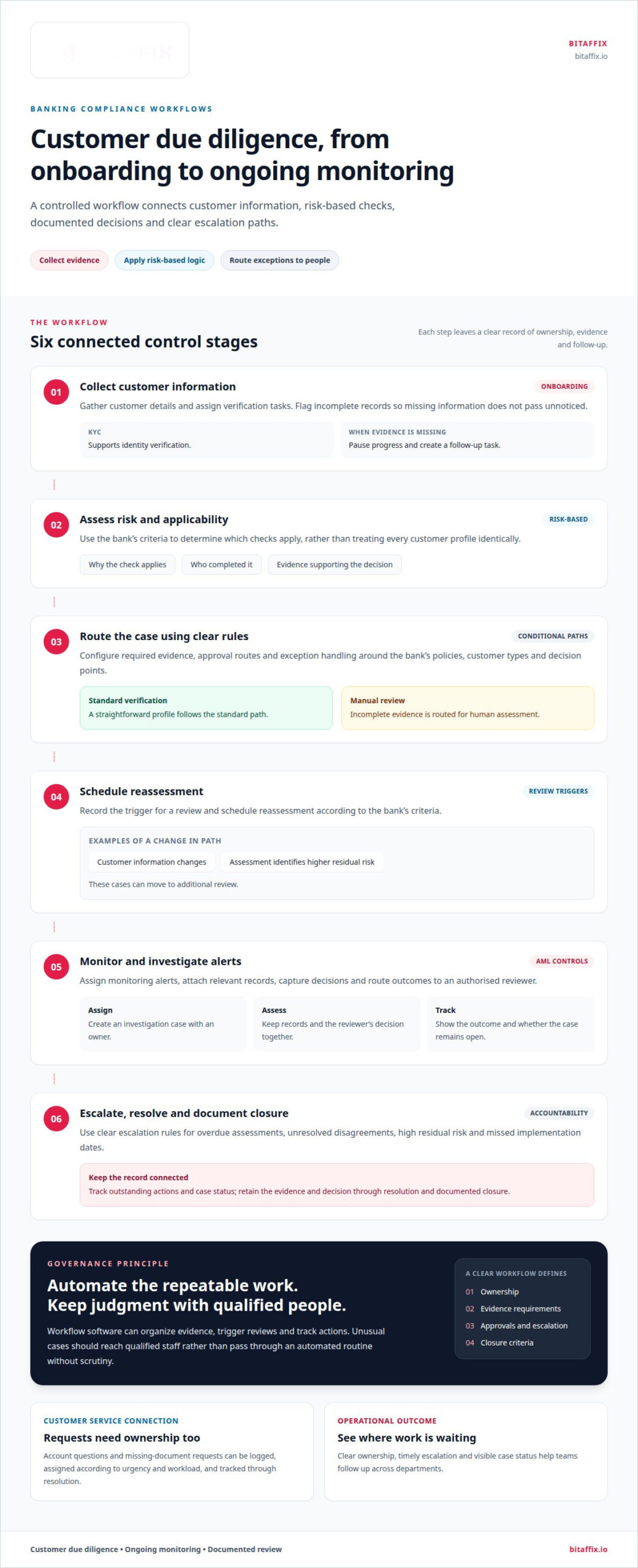
Customer due diligence connects onboarding, identity checks, risk assessment, and scheduled reassessment in a controlled process. For a UAE bank, the workflow should record why each check applies, who completed it, and what evidence supports the decision. This creates a consistent path from the initial application to later review without treating every customer profile identically.
During onboarding, a workflow can collect customer information, assign verification tasks, and flag incomplete records. Know Your Customer (KYC) checks support identity verification, while Anti-Money Laundering (AML) controls help institutions assess and respond to relevant risks. For example, a missing document can pause progress and create a follow-up task instead of allowing an incomplete case to move forward unnoticed.
Risk-based logic determines what happens next. A workflow can apply conditional requirements, record the trigger for a review, and schedule reassessment according to the bank’s criteria. If customer information changes or an assessment identifies higher residual risk, the case can move to additional review. Clear rules also help explain why different customer profiles follow different paths.
Ongoing monitoring requires more than periodic reminders. Banking teams need to assign alerts, capture decisions, and track unresolved actions. A monitoring alert might create an investigation case, attach relevant records, and route the outcome to an authorised reviewer. Escalation rules can address overdue assessments, unresolved disagreements, high residual risk, and missed implementation dates. Reports can show outstanding cases and their status.
Case management also supports customer service. A request about an account or a missing onboarding document can be logged, assigned according to urgency and workload, and tracked through resolution. This links customer requests to internal follow-up and helps teams see where a case is waiting. Clear ownership and timely escalation reduce the chance that requests go unnoticed between departments.
Custom workflow creation means configuring steps around an institution’s policies, customer types, and decision points. Teams can define required evidence, approval routes, reassessment triggers, and exception handling before deployment. For example, a straightforward profile might follow standard verification, while a case with incomplete evidence goes to manual review. Transparent routing rules make these paths easier to manage and test.
For institutions shaping these processes, a workflow design discussion can help clarify requirements, ownership, and escalation logic before configuration.
Banks can also automate loan processing, customer onboarding, regulatory reporting, fraud detection, and audits. Tasks related to customer requests can be assigned dynamically according to urgency and workload to help prevent SLA breaches.
Implementation timelines and legacy-system integration
Integration, data quality, process ownership, and change management all shape implementation. A focused workflow can be deployed in weeks, while an enterprise-wide rollout takes several months. Measure results using indicators such as triage time, overdue actions by risk rating, and closed items with complete evidence.
Start with one high-value use case, such as sanctions alert escalation or policy review. Before configuration, map the existing steps, owners, evidence, and exception paths. This limits disruption and gives teams a clear scope for testing. Once the workflow operates reliably, banks can apply what they learn to additional departments and processes.
Legacy integration often requires coordination across systems that store different parts of a case. A customer record may be in a CRM application, loan details in a Loan Origination System, and financial data in an ERP platform. The workflow must retrieve relevant data, route tasks, and preserve links between source records and decisions. Middleware can connect applications when direct integration does not suit the architecture.
Address data mapping and access controls early. For example, a field used to identify a customer must retain a consistent meaning as information moves between systems. Test scenarios should include missing fields, duplicate records, rejected updates, and interrupted transfers. These tests show whether the workflow can keep operations moving without losing evidence or obscuring exceptions.
Establish governance before configuration. Banks need a regulatory-change taxonomy, ownership model, materiality thresholds, escalation paths, evidence standards, and closure criteria. Route each requirement according to potential impact, implementation deadline, jurisdiction, and affected control domain. This sets decision logic before software automates task assignment, reporting, and internal approvals.
Scalability depends on more than user numbers. Banks should assess how a platform handles growing case volumes, additional business units, new jurisdictions, and changing control requirements. Workflow intelligence can help teams identify trends, such as recurring exceptions or bottlenecks, but decision-makers still need clear rules for responding to them.
Software costs depend on implementation scope and operating needs. Integration complexity, data migration, configuration, user access, training, and ongoing support all affect total cost. Transaction volume and the ability to reuse workflows across departments can also shape the business case. Assess these factors against expected reductions in manual handoffs and stronger evidence control, rather than relying on task-closure counts alone.
Establish a baseline and use consistent measures to track results. Compare triage time before and after launch, monitor overdue actions by risk rating, and check whether closed items contain complete evidence. These indicators show whether implementation improves timeliness and control quality, not just whether the system processes more tasks.
Platform integration, compliance, scalability and cost
A banking platform must connect operational systems while preserving access controls, traceable records, and usable data. Banks can assess these capabilities through a structured selection and implementation process.
Security and Software Selection
Security and software selection assess how a platform protects information and supports controlled operations. Banks should evaluate encryption, complete audit logging, configurability, scalability, usability, and vendor support. SOC 1, SOC 2, and ISO 27001 are standards that may inform a compliance-management assessment. For example, audit logs should make user actions and workflow changes traceable, while access controls should align with defined responsibilities.
A step-by-step selection process keeps governance and implementation connected:
- Define the workflow’s purpose, owners, evidence requirements, approval logic, and closure criteria.
- Map the systems and data the process needs, including CRM, loan origination, and ERP platforms.
- Assess integration, security, configurability, scalability, vendor support, and usability against those needs.
- Test a focused workflow with representative records, exceptions, permissions, and reporting outputs before broader deployment.
This sequence gives the organization a practical basis for evaluating platform fit. It also helps teams identify operational dependencies before implementation expands across the enterprise.
Integration with Banking Systems
Integration connects workflow tasks with systems that hold customer, loan, and finance records. A platform can exchange information with CRM applications, Loan Origination Systems, and ERP platforms, then route work based on the relevant record. This can streamline handoffs, but data meaning, access permissions, and update behavior must remain clear in each system.
Data integration also supports analysis and reporting. A workflow can gather information from multiple sources, validate and format it, then share it with relevant stakeholders. For example, a reporting process can flag incomplete fields for resolution before compiling its output. Mapping data definitions and handling duplicates or failed transfers helps prevent inconsistent records from passing silently between applications.
Scalability means more than adding users. Banks should assess whether a platform can handle higher case volumes, additional departments, and evolving reporting needs without weakening controls. A growing organization may need configurable workflows that reuse common approval logic while preserving distinct access rules. Testing these scenarios helps reveal where integration or process design could limit future expansion.
Cost analysis should account for the work involved in connecting systems and operating the platform. Integration complexity, data preparation, configuration, training, support, and ongoing maintenance influence total investment. Transaction volume and the ability to reuse workflow components also affect the business case. Banks can compare these factors with measurable outcomes, such as fewer manual handoffs and more complete evidence records, rather than task counts alone.
Banking compliance workflow definition
A banking compliance workflow is a controlled sequence that links a regulatory requirement to assigned work, evidence, review, and closure. Its purpose is not simply to move tasks between teams. It shows how a bank translated an obligation into policies, controls, accountable actions, and documented outcomes. For example, a new requirement affecting transaction monitoring should prompt an applicability decision, control assessment, any necessary remediation, and evidence of completion.
A well-defined workflow starts with a regulatory event and ends with evidenced closure. Before configuring banking compliance workflow software, the bank defines its taxonomy, ownership model, materiality thresholds, escalation paths, evidence standards, and closure criteria. These elements determine which teams act, what they record, and how reviewers assess the result. Without this structure, automation can move work faster while leaving control gaps unresolved.
Consider a regulatory development that may affect customer onboarding controls. The workflow first classifies its status, such as final or proposed, then assigns an impact assessment based on jurisdiction, deadline, and affected control domain. The assessment records whether the requirement applies, affected policies and controls, identified gaps, risk, proposed remediation, and any assumptions or legal interpretations. Teams should use the underlying primary source when assessing applicability.
Next, the bank assigns approved remediation to a named owner and links each action to the relevant control inventory. Implementation and validation remain separate: the responsible team makes the change, while a reviewer assesses evidence that it works. For high-risk changes, a second-line review or targeted control test should precede closure. This separation creates a stronger decision trail than marking a manual task complete without supporting evidence.
Workflow rules need transparent routing and regular testing. A rule that sends a critical policy change to the wrong department can delay action, even if every task appears on schedule. Test cases should cover different jurisdictions, affected controls, overdue actions, and disputed applicability decisions. For a global bank, minimum evidence, approval logic, and reporting taxonomy can be standardized while local implementation varies by jurisdiction.
Measure workflow quality through triage time, overdue actions by risk rating, and closed items with complete evidence. A high task-closure count alone can reward premature closure or produce noisy reporting. Strong integration links remediation, source records, approvals, and control evidence so an auditor can trace the decision from regulatory event to final validation. The practical takeaway: define ownership and proof of closure before automating the sequence.
BitAffix: Workflow Automation
BitAffix provides Workflow Automation and Banking Sector Solutions for banks seeking to structure compliance work across teams. These offerings suit processes that need defined responsibilities, review stages, and documented task progress within a consistent workflow.
Kanban Task Automation makes task ownership and progress easier to track, while Secure Document Archiving supports organized management of compliance records. Together, these capabilities address practical workflow needs: coordinating actions, maintaining accessible documentation, and improving visibility into work in progress. Start with a specific process that has defined owners, evidence requirements, and approval paths.
Contact BitAffix to discuss your banking workflow requirements.
Align Compliance Workflows With the Bank’s Next Stage
Make the next decision architectural, not merely technical. As products, customer channels, and operating models evolve, compliance processes need to stay aligned with how the bank operates. Treat banking compliance workflow software as part of that operating model, with clear accountability for reviewing process changes and their effects on controls. This keeps governance connected to business decisions rather than isolating it within a technology project.
A practical next step is to select one process that regularly creates friction across teams, then define the desired operational outcome. That might mean clearer ownership, smoother coordination, or more accessible evidence. Use these priorities to guide a focused discussion about workflow design and the role automation should play. The goal is lasting alignment between people, processes, and systems, not automation for its own sake.
Start with a clear operational purpose, then strengthen the process as your bank’s needs evolve.
Frequently Asked Questions
What is banking compliance workflow software and what tasks does it automate?
Banking compliance workflow software coordinates repeatable control tasks and makes ownership visible across a bank. It can route customer files for review, assign policy attestations, escalate overdue actions, and organize evidence for internal examinations. For example, when a document expires, a configured process can create a reassessment task and notify the responsible team. Staff still decide how to resolve exceptions and interpret complex cases.
What are the leading banking compliance workflow software platforms in 2026?
There is no single platform that leads for every bank in 2026; fit depends on processes, architecture, and governance needs. A regional institution may prioritize configurable approvals and manageable integration, while a larger bank may need centralized controls across business units. Assess platforms against a real workflow scenario, such as an overdue sanctions alert, and review how each handles exceptions, evidence, access, and reporting.
How do banking compliance platforms compare on features, integrations, and scalability?
Compare platforms by testing the same operational scenario, not by counting feature names. Check whether a platform supports configurable routing, approval controls, complete audit logs, and connections to the bank’s CRM, loan, and finance systems. Then examine how administrators can reuse workflows across departments without losing local control. Scalability means accommodating more processes and teams while keeping permissions, reporting definitions, and oversight consistent.
What are typical pricing models and costs for banking compliance workflow software?
Pricing structures may charge by user, transaction volume, selected modules, or enterprise deployment scope. Total cost can also reflect integration work, data migration, configuration, training, support, and ongoing administration. For UAE budgeting, compare proposals in AED and separate recurring charges from implementation costs. A useful estimate starts with the workflows, expected users, integration requirements, and operating model, not a headline subscription figure alone.
Which AML, KYC, sanctions screening, and transaction monitoring features should banks look for?
Look for configurable case routing, clear alert prioritization, documented reviewer decisions, and links between an alert and its supporting records. For sanctions screening, teams need to investigate potential matches and record why they were resolved or escalated. KYC processes should track missing or outdated customer details. Transaction monitoring workflows should support alert assignment, investigation notes, escalation, and controlled closure, with human review of exceptions.
What data security, privacy, and cloud-hosting risks should banks assess?
Assess who can access sensitive records, how the platform encrypts data, and whether audit logs capture administrative and user actions. Review hosting locations, backup arrangements, retention controls, subcontractor access, incident handling, and data export options. For a cloud deployment, clarify how access changes when employees change roles and how records remain retrievable during service disruption. Test controls against realistic scenarios, including a compromised account or failed integration.