
The right alternative to Camunda depends on who needs to own the workflow and how it should behave when something fails. Choose Camunda when engineering teams need control over BPMN execution, complex integrations, and recovery paths. Choose a no-code engine when business teams need to manage routine workflow changes within clear operational boundaries. That is the central decision in comparing Camunda vs no-code enterprise workflow engines.
Both approaches can support enterprise processes, but they assign responsibility differently. A visual builder can make changes more accessible, but it does not remove the need to define ownership, escalation, auditability, and support when a workflow stalls.
This comparison explains how BPMN execution, workflow ownership, failure handling, operations, and governance shape the decision. Use it to match an engine to the people maintaining the process and the level of control it requires.
Key Takeaways
- Map each workflow’s decisions, handoffs, and exception paths before choosing how teams will model and run it.
- Define who responds to stalled tasks and failed integrations; recovery ownership should shape the engine decision.
- Account for upgrades, backups, monitoring, and migration effort alongside the workflow builder’s ease of use.
- Set governance around change permissions, decision rules, and audit records so flexibility does not weaken control.
- Compare cloud and self-hosted deployment against your security, operations, and infrastructure responsibilities.
BPMN workflow modelling and execution
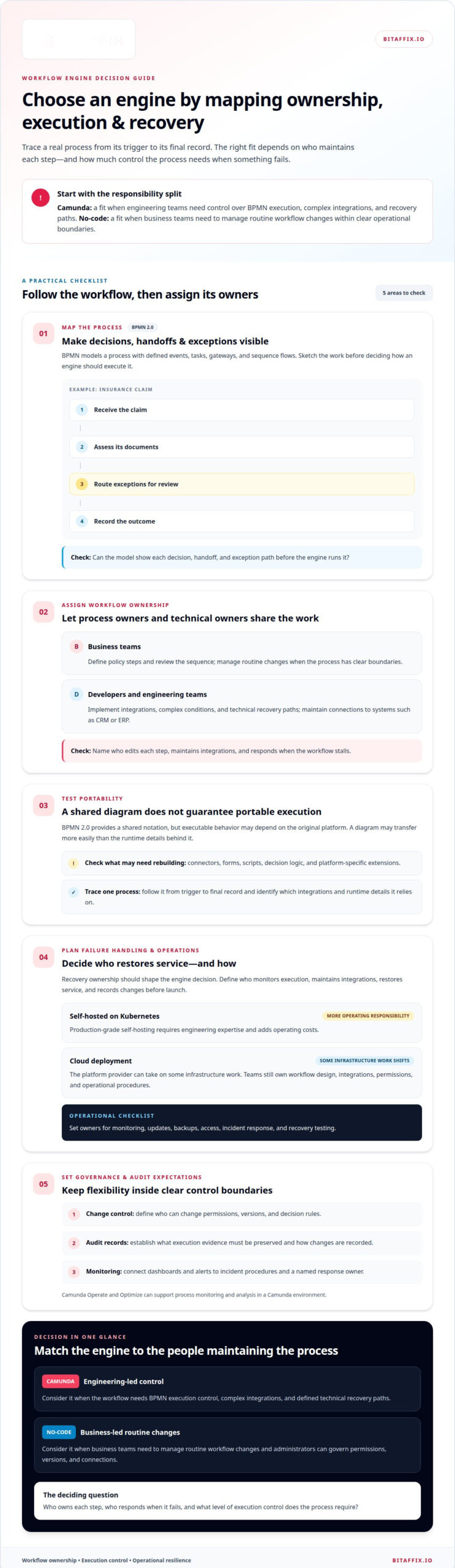
BPMN turns a business process into a visual model with defined events, tasks, gateways, and sequence flows. In BPMN 2.0, teams can represent a process such as an insurance claim: receive the claim, assess its documents, route exceptions for review, and record the outcome. The model makes handoffs visible before an engine executes them.
Camunda is associated with BPMN-based workflow execution, while no-code platforms often prioritize visual configuration for business teams. The distinction is not simply code versus no code. It is who owns each model, who can change it, and how precisely it must direct distributed services. For example, a customer-care workflow might escalate a case to a supervisor as its SLA approaches expiry.
BPMN 2.0 supports a shared notation, but portability is not automatic. A diagram may move between tools more easily than its executable behavior. Connectors, forms, scripts, decision logic, and platform-specific extensions can bind a model to its original engine. Treat the diagram as a useful starting point, then assess which runtime details and integrations need rebuilding.
Open-source BPMN workflow platforms can give engineering teams greater visibility into the model and execution architecture. They also make the organization responsible for operating and governing the platform. A no-code designer can lower the barrier for business teams, but administrators still need to control permissions, version changes, and connections to systems such as CRM or ERP.
Workflow authorship should follow process ownership. Business teams can define policy steps and review the sequence; developers can implement integrations, complex conditions, and technical recovery paths. For example, a flight reservation flow may hold a ticket for 24 hours, then release it if purchase completion does not arrive. The model must express both the wait and the resulting action.
Compare the camunda vs no-code enterprise workflow engines decision by tracing one process from its trigger to its final record. Identify who edits each step, who maintains integrations, and how exceptions return to a person or system. That exercise reveals whether BPMN execution control or visual configuration better fits the process. A robust workflow automation architecture makes those ownership boundaries explicit.
Pricing and licensing models vary by platform and may include open-source terms or commercial subscriptions. Actual pricing depends on licensing scope, deployment, user access, execution volume, and support, and is provided after a quote request.
Replacing Camunda to introduce agents can create two orchestration models and operating practices. The transition is therefore an operating-model decision as well as a change in execution technology. Teams should consider how orchestration responsibilities fit together and whether each process has a clear owner. Compare the work the workflow must coordinate, not just its visual model or runtime.
Halkbank’s money-transfer processing became 600% faster, improving from 54 seconds to nine seconds. Halkbank reduced money-transfer processing time from 54 seconds to nine seconds, and its money-transfer processing had 50% fewer errors. These results offer concrete outcomes to weigh alongside ownership and operational complexity when evaluating workflow changes; they do not remove the need to decide how the process and its orchestration should be governed.
Operations, migration, availability, upgrades, backups, and auditability
Operational ownership determines whether workflow automation remains manageable after launch. Compare who monitors execution, maintains integrations, restores service, and records changes in each deployment model.
Deployment and Operational Resilience
Deployment and operational resilience concern how an engine runs and how teams sustain it through incidents and change. Camunda can suit engineering and operations teams that need direct control over orchestration; no-code platforms can reduce the technical effort involved in routine process updates. Neither approach removes the need to plan upgrades, backups, access, and recovery responsibilities.
Production-grade self-hosting on Kubernetes requires engineering expertise and adds operating costs. Cloud deployment can shift some infrastructure work to the platform provider, while teams remain responsible for workflow design, integrations, permissions, and operational procedures. Before choosing where the engine runs, establish who monitors execution, applies updates, and tests recovery.
Centralized dashboards can track task completion, show dependencies, and flag workflow bottlenecks in real time. Camunda Operate and Optimize can support process monitoring and analysis in a Camunda environment. Connect these views to incident procedures so an alert reaches a named owner with a defined response, rather than becoming another isolated dashboard.
Migration, Auditability, and Platform Limits
Migration and auditability involve transferring process logic and preserving the records needed to explain execution. A workflow may contain business rules, integrations, and operational history that a diagram alone does not capture. Before moving an engine, map its data, decision logic, connectors, and evidence requirements.
Replacing Camunda to introduce agents can create two orchestration models and operating practices. This split can increase coordination needs if teams monitor different systems or apply separate change controls. A migration plan should identify which process stays in each environment, who owns incidents, and how teams will reconcile records during the transition.
Integration and API requirements also shape implementation. No-code platforms often provide visual connectors for common systems, while custom endpoints or unusual data transformations may require developer support. Camunda workflows can also depend on APIs and code for integrations. Unified data access across CRM, ERP, and HR systems can reduce manual switching, but permissions and data handoffs still need governance.
Technical effort depends on complexity. Business users can maintain straightforward routing rules in a no-code designer, while engineers handle complex integrations, exception paths, and deployment controls. A no-code engine may be limiting when a process requires specialized logic, precise recovery behavior, or tightly coordinated services. Plan onboarding around these boundaries, not just the ease of creating the first model.
For a clear operational baseline, map workflow ownership and recovery responsibilities before selecting a platform.
Choosing an engine by workflow ownership and failure requirements
Choose an engine based on who owns process changes and who responds when execution fails. Procurement might own a supplier onboarding process, while engineering oversees its identity checks and system connections. The right orchestration platform lets each group work within clearly defined responsibilities.
Start with authorship. If business teams adjust approval paths, a visual process model can support controlled edits without making every change a software release. If developers own the process logic, integrations, and deployment, Camunda’s engineering-oriented approach may fit more directly. Either way, assign a named owner to approve each model version.
Define failure behavior before comparing tools. For a bank payment workflow, decide what happens when a receiving system rejects a request: retry, send it for review, or stop execution and alert an operator. The right response depends on whether the process can safely resume and which team can diagnose the error.
Assess each workflow against operational responsibilities:
- Business ownership: For a purchase approval, identify who changes approval rules and who authorizes a revised process model.
- Technical ownership: For a failed ERP connection, name the team responsible for diagnosing the API and restoring data flow.
- Failure ownership: For a duplicate payment risk, define which step pauses execution and who confirms safe recovery.
- Change control: For a revised supplier review, retain the active version and identify who releases its replacement.
No-code automation suits bounded processes where business teams can manage predictable rules and exceptions. A leave request with standard routing may fit if the organization can clearly define access, approvals, and escalation. No-code is less suitable when a process depends on complex software logic, coordinated transactions, or exception paths requiring developer intervention.
Camunda can be a stronger option when engineering teams need to govern execution across services and manage detailed process behavior. That control also brings implementation and operating responsibilities: teams need the skills to maintain integrations, deployments, and recovery procedures. A process that only routes a form may not warrant that engineering effort.
Test ownership against a real process, not a feature checklist. Take a supplier onboarding model from request to completion, assign each change and failure to a role, then trace what happens when a document is missing or a system connection fails. If business teams can safely maintain routine changes while technical teams own complex exceptions, responsibilities are clear. If every edit requires engineering, or no one owns recovery, revise the operating model before selecting an engine.
Compliance, governance, and auditability
Governance defines who can change a workflow, what evidence it records, and how decisions remain explainable. In a customer onboarding process, teams need controlled access, traceable approvals, and clear records of exceptions at each handoff.
For enterprises in the UAE, neither Camunda nor a no-code engine is automatically the best choice for data residency, local compliance, or regional support. Select a platform and deployment arrangement that meet the organization’s requirements for data location, access control, audit, and support.
Set workflow permissions according to accountable roles. In a bank’s customer onboarding flow, business teams might own approval criteria while developers implement integrations and access controls. Separate editing rights from approval rights, then record each process-model change and its approver. This lets organizations adapt workflows while retaining oversight of who changed a decision path.
Decision automation also requires disciplined rule management. DMN capabilities can help organizations adapt decisions to changing regulations, policies, and market conditions. For example, a customer eligibility rule can be maintained separately from the workflow sequence, allowing authorized owners to update criteria while developers manage the surrounding integration and execution logic.
Auditability depends on capturing the events that explain a process outcome. A customer onboarding record should show when information arrived, which decision rule applied, who reviewed an exception, and whether the process completed. Camunda-oriented implementations can make process execution visible to technical teams; no-code platforms can show activity through their workflow views. In both cases, configure records to meet the organization’s review needs.
Data controls should follow information through every connected system. Automated workflows can encrypt sensitive information and restrict access to authorized personnel to help verify customer-data compliance with GDPR. For an organization in the UAE handling data across jurisdictions, map each system that receives customer information and assign permissions to the people and services that need access.
Reporting adds another layer of governance. Automated workflows can generate and submit regulatory reports on time, helping prevent delays or fines. A finance team can define which approved data feeds a report, which role reviews it, and what record demonstrates submission. These controls matter whether the process uses BPMN or a visual designer.
- Define ownership: Assign process changes, rule approvals, and exception handling to named roles.
- Preserve evidence: Capture decision inputs, approvals, changes, and completion events for each process.
- Control access: Limit customer-data visibility to authorized users and connected services.
- Review deployment: Match data location and support arrangements to the organization’s UAE operating requirements.
Governance should shape the engine decision, not follow it. A platform earns a place in a UAE enterprise architecture when its deployment, access model, decision records, and support arrangements align with the process’s actual obligations.
What are the deployment options for Camunda and leading no-code workflow platforms, including self-hosted and cloud?
Deployment choices determine who operates the engine, controls its environment, and maintains its connections. When comparing Camunda and no-code platforms, assess self-hosted infrastructure and cloud deployment against the same operational requirements. The right model depends on existing skills, data-handling needs, integration architecture, and responsibility for ongoing operations.
With self-hosting, the organization runs the workflow platform within its own infrastructure. A Camunda deployment on Kubernetes, for example, requires engineering expertise and adds operating costs. Internal teams manage the surrounding environment, including deployment procedures, monitoring, upgrades, and backups. This approach offers direct operational control, but it also creates ongoing work for platform and operations teams.
Cloud deployment shifts some infrastructure operations to a hosted environment. The organization still needs to assess how the platform connects to internal systems, who manages workflow changes, and how operational records remain accessible. For a UAE-based bank, a cloud design might connect a workflow to internal banking applications; teams must map each integration and its data movement before production.
No-code platforms also differ in how they deliver cloud and self-hosted options. A visual workflow designer may run as a hosted service, while execution, connectors, and data may involve separate components. Do not assume a browser-based builder means every part of the business process runs in the same environment. Trace a sample process, such as an employee approval, from its form through each system to its final record.
Compare the operating responsibilities before selecting a deployment:
- Infrastructure: Identify who provisions, monitors, and updates the environment for a Kubernetes-based Camunda installation or hosted platform.
- Integration: Map how a workflow reaches systems such as an internal ERP, and assign ownership for connection failures.
- Recovery: Define how teams restore workflow execution and records after an infrastructure or service interruption.
- Change management: Set a release path for revised process models, including testing and approval before production.
- Audit access: Determine which operational records administrators and process owners can review during an investigation.
Cloud deployment can reduce direct infrastructure responsibilities, while self-hosting provides greater control over the operating environment. Neither option removes the need for clear owners, documented recovery procedures, and tested backups. For a complex process spanning several systems, assess the full deployment architecture, not just the designer. This keeps the engine aligned with operational capacity and business requirements.
Test deployment decisions against the work they are intended to improve, not only the engine’s location. Automation platforms can orchestrate workflows across CRM, ERP, and HR systems, enabling data flow and task execution without employees switching between tools or reconciling information manually. Include the end-to-end process and staff responsibilities in a deployment review: confirm where the process runs and whether teams can manage its connections and records under the chosen model.
Halkbank re-deployed 32 employees to higher-value work after improving money-transfer processing. This illustrates a business outcome to consider alongside infrastructure control: assess whether the operating model supports process improvement and allows people to focus on higher-value work. A useful comparison weighs operational ownership against the workflow’s intended effect, rather than treating cloud or self-hosting as a goal by itself.
BitAffix: Workflow Automation
BitAffix offers Workflow Automation for organizations translating process ownership and failure requirements into operational workflows. It is a natural next step when teams need to coordinate approvals, handoffs, and task visibility across a business process. The appropriate design starts with the process, its owners, and the exceptions teams must manage.
For work requiring visible task coordination, BitAffix’s Kanban-Based Process Automation supports structured task flows. Secure Document Management & Archiving addresses document retention needs, while its pre-built Banking solution supports sector-specific workflows. These capabilities can complement platform decisions, but they do not replace governance or clear operational ownership.
Bring a defined process, its key handoffs, and its exception paths into the discussion. Contact BitAffix to discuss workflow automation for your organization.
Set the next workflow up for a controlled decision
The Camunda vs no-code enterprise workflow engines decision becomes clearer when you start with one important process. Choose a workflow with clear ownership, meaningful exceptions, and assessable outcomes. Define what a successful run means, who approves changes, and how operators respond when the process stops. This gives you a practical basis for evaluating the engine in your operating environment.
Use the pilot to test more than the model. Trace a change from approval to release, examine how the process handles an exception, and confirm that business and technical owners can interpret its records. Use those observations to shape the broader automation roadmap. A disciplined evaluation helps teams proceed with defined responsibilities and fewer assumptions.
Choose a platform that fits the people accountable for its execution, and make the first workflow a foundation for confident progress.
Frequently Asked Questions
How do the platforms compare on scalability, reliability, security, and compliance?
Both can support enterprise requirements when configured and operated to suit the process. Camunda gives engineering teams control over execution architecture, while no-code platforms can make routine workflow changes accessible to business owners. For a practical assessment, model a peak-demand scenario, simulate a failed downstream system, review role permissions, and inspect records from a sample transaction. Compare the results with your organization’s operational and compliance criteria.
What are the pricing and licensing models for Camunda and enterprise no-code workflow platforms?
Pricing and licensing vary by platform and may involve open-source terms or commercial subscriptions. Costs depend on licensing scope, deployment, user access, execution volume, and support.