
A letter is only as controlled as the systems and teams that move it. An end-to-end letter workflow management system for retail banks coordinates each stage, from document creation and review to approval, delivery, and recordkeeping. Banking workflow automation extends beyond digitizing a form: it orchestrates people, systems, and handoffs across the process.
That distinction matters. Automating one task may streamline a step, but it will not resolve disconnected workflows or unclear handoffs between teams and platforms. Retail banks need consistent process control and the flexibility to support different letter types and approval paths.
This article explains how banking workflow automation applies to letter operations, and how cross-system coordination can improve traceability, reduce manual handling, and support a more consistent customer experience. It covers the components of an end-to-end workflow, implementation and cost considerations, and how workflow automation can fit into a bank’s existing operations.
Key Takeaways
- Coordinate letter creation, review, approval, and delivery as one controlled process rather than a series of disconnected tasks.
- Connect front-office and back-office work so teams can manage handoffs with clearer ownership and fewer manual steps.
- Plan integration around how core banking and legacy systems exchange information, while preserving established operations.
- Build governance into workflow design with defined approvals, access boundaries, and records that support auditability.
- Use cross-system workflow automation and secure document archiving to bring greater consistency to bank letter operations.
Benefits including faster processing, reduced costs, fewer errors, compliance, and customer experience
For UAE banks, letter workflows can reduce manual handoffs by coordinating intake, drafting, approval, dispatch, and recordkeeping. Bank communications should follow applicable Central Bank of the UAE banking and consumer-protection requirements, as well as UAE data-protection requirements relevant to the communication and its information.
Faster Processing and Lower Costs
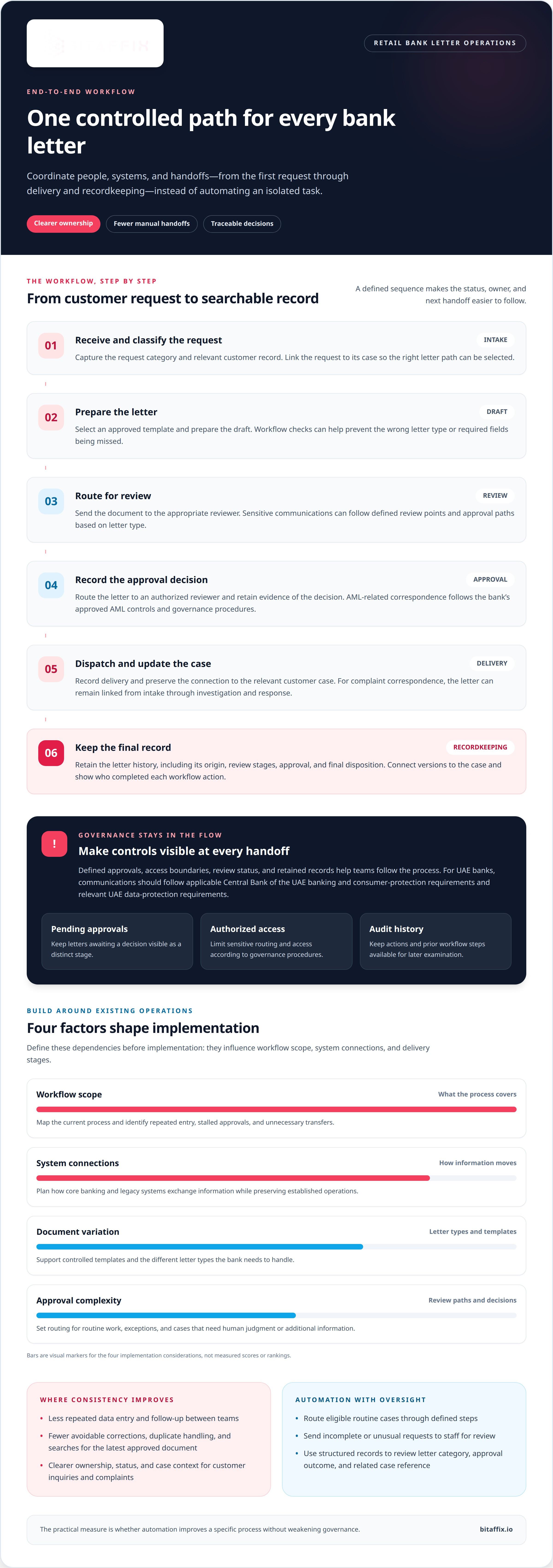
Processing is more consistent when a request follows defined steps instead of moving between separate email queues and manual trackers. For example, a service team can log a customer request, route it to the appropriate letter template, and send it for review in one orchestrated flow. This reduces repeated data entry and follow-up between teams.
Cost control starts with reducing avoidable rework, duplicate handling, and time spent locating the latest approved document. Banks should identify where staff re-enter customer details, wait for approvals, or recreate letters after corrections. A clear workflow makes these pressure points visible, helping teams target process changes without compromising review.
Fewer Errors in Letter Handling
Standardized templates and workflow checks help prevent common errors, such as choosing the wrong letter type, omitting required fields, or sending a draft before approval. At intake, the process can capture the request category and relevant customer record. Before release, it can route the document to an authorized reviewer and record the decision.
Consistent classification also supports customer inquiry and complaint handling. A complaint letter, for example, can stay linked to its original case as it moves from intake to investigation and response. Teams have a clearer view of ownership and status, and customers receive communications based on the correct case context.
Compliance Checks and Reporting
Compliance controls belong in the workflow, not in a separate manual reminder. Banks can set review points for sensitive communications, apply approval paths based on letter type, and retain evidence of completion. AML-related correspondence should follow the bank’s approved AML controls, with access and routing limited according to its governance procedures.
Regulatory reporting relies on reliable records and consistent classification. A workflow can capture the letter category, approval outcome, and related case reference, giving compliance teams structured information to review. Complaint responses can follow a controlled path from receipt through investigation and resolution, helping teams monitor handling and identify recurring issues.
Audit Trails and Compliance Tracking
An audit trail records a letter’s progress, including its origin, review stages, approval, and final disposition. Authorized teams can follow this history instead of searching through scattered email attachments. Banks should assess whether records connect each version to its case and show who completed each workflow action.
Compliance tracking is more practical when governance rules and workflow status are visible together. Teams can identify pending approvals, incomplete reviews, and records needing attention. For example, a letter awaiting a compliance decision remains visible as a distinct stage, with its previous actions available for later examination.
What is banking workflow automation?
Banking workflow automation coordinates people, systems, and tasks across a defined process. It connects customer-facing activity with back-office execution instead of automating an isolated step.
Connecting Front- and Back-Office Operations
For example, customer onboarding may begin through a branch or digital channel, then move to operations for document review and account setup. Automation routes each task with its relevant data, so teams can act without rebuilding the request from separate messages. Banks should examine how the workflow handles exceptions, changes in ownership, and status visibility.
An end-to-end letter workflow management system for retail banks applies the same coordination to correspondence, from request intake through drafting, approval, and delivery. Its features should support controlled templates, review routing, dispatch records, and links to the relevant customer case.
Process Orchestration and Optimization
Orchestration defines the sequence, decision points, and handoffs in a banking process. Automation can route routine cases while directing incomplete or unusual requests to staff. This supports straight-through processing for eligible work while preserving human review when judgment or additional information is needed.
Process optimization starts with mapping how work currently moves. Teams can identify repeated entry, stalled approvals, and unnecessary transfers, then adjust routing and responsibilities. 96% of IT decision-makers and business leaders say automation is vital to digital transformation. For banks, the practical measure is whether automation improves a specific process without weakening governance.
Automating Financial Document Workflows
Financial documents often pass between customer service, operations, and compliance teams. Automation can associate a document with its case, apply the appropriate workflow, and move it through designated review stages. For a letter request, the sequence may include selecting an approved template, preparing a draft, obtaining review, and recording delivery.
Implementation cost and timeline depend on workflow scope, system connections, document variation, and approval complexity. Before implementation begins, define these dependencies, delivery stages, and measures of performance. In the UAE, banks can assess enterprise workflow automation and banking-sector solutions against those requirements, prioritizing integration fit, governance, and measurable process outcomes over feature volume alone.
To shape an implementation around the bank’s correspondence process, discuss workflow scope.
Banking workflow orchestration can sequence process steps, enforce approvals and segregation of duties, and keep a single audit trail. These controls make handoffs and accountability part of the workflow, alongside the movement of documents and tasks. In retail banking, loan application agents reduce co-applicant processing time by 30%. Loan approval and agreement documentation agents reduce sanction letter and agreement creation time by up to 30%. Disbursement and EMI schedule agents reduce processing and schedule generation time by 40%.
Efficiency improvements of 20-45% are reported across document-heavy, high-volume banking workflows. In commercial banking, financial statement, cash flow, and debt service agents reduce financial data extraction and analysis time by 40-45%. These examples span loan applications, approvals, disbursement, and financial analysis. They show how workflow automation can coordinate both task sequences and the documents involved, while keeping approvals and auditability within the process. The relevant measures are the work being reduced and the stage where the improvement occurs.
Integration with core banking and legacy systems
Integration connects letter workflows with banking applications that hold customer and case information. A sound design preserves existing systems while controlling how data moves between them.
Connect Applications Through Defined Data Flows
A letter request may start in a branch, contact centre, or digital channel. The workflow can pass its case reference to a core banking platform, retrieve approved customer details, and return a status to the originating application. Each exchange should define its data fields, trigger, and exception route.
Legacy systems may use different interfaces or data formats from newer applications. Map those differences before configuration begins. For example, middleware can translate a legacy field into a format the correspondence workflow can process, while checks identify missing or mismatched information before drafting.
Repetitive, document-heavy banking work is a practical starting point. A bank can map one high-volume process, such as generating loan correspondence, and identify its data sources, handoffs, and review points. The process map helps teams decide what to integrate first and which exceptions still need staff attention.
Apply Automation and AI Agents Selectively
AI agents can support defined banking service operations, such as extracting information from application documents or preparing a draft for review. They need clear inputs, decision boundaries, and escalation routes. For example, a document with conflicting customer details can go to an employee rather than continue automatically.
Automation should distinguish routine processing from decisions requiring human judgment. Straight-through processing can handle cases that meet the bank’s configured checks, while incomplete applications move to a review queue. This lets teams manage exceptions without interrupting every standard transaction.
Low-code workflow design can help authorized teams adjust routing or approval steps as processes change. Governance still matters: changes need defined ownership, testing, and release controls. Low-code configuration should make process logic easier to maintain, not obscure how a customer document reached its next stage.
Scale Infrastructure With Integration Fit
Scalable infrastructure should support additional workflows, channels, and document volumes without creating separate, disconnected processes. Banks should assess how a platform handles shared data, permissions, workflow changes, and system interruptions. For instance, a failed connection should leave a case visible for controlled follow-up, rather than silently losing its status.
Compare platforms by integration fit, automation scope, and scalability, not rankings alone. Assess whether each can connect existing banking applications, route exceptions, and extend to new processes without duplicating controls. A pilot with one document workflow can reveal practical gaps before broader digital transformation work begins.
Governance and auditable risk boundaries
Governance defines which users can create, review, approve, and release bank letters. For a lending notice, those boundaries should separate document preparation from final approval.
Governance Controls
Assign each workflow action to a defined role. A credit operations employee might prepare a decision letter, while an authorized manager reviews its content before release. Access rules should reflect the document’s sensitivity and each user’s responsibilities. This clarifies accountability without giving every participant authority to change every stage.
Risk boundaries also define which cases can proceed automatically and which need escalation. For example, a standard account update may follow a routine route, while a lending communication with missing information pauses for review. Institutions should document these conditions in process rules, including who can resolve exceptions and how the workflow records the decision.
Volume adds another governance consideration. High-volume correspondence needs consistent routing, but operational speed must not bypass required reviews. Process owners can define approved templates, permitted edits, and release conditions, then test each path with representative cases. These controls help align routine execution with the institution’s risk appetite and internal policy.
Approvals and Audit Trails
Approval design should match the decision represented by each letter. A credit outcome, for instance, may need a different review path from a routine service response. The workflow should identify the responsible approver, prevent unauthorized release, and return rejected drafts to the correct owner with a recorded reason.
An audit trail should connect the request, document versions, decisions, and final action under one case reference. If a reviewer changes a lending letter, the record should show the revised version and subsequent approval, rather than leaving staff to reconstruct events from email. This lets an authorized reviewer trace the letter’s execution from intake to closure.
Governance teams can use these records to assess workflow performance and adherence to controls. They can review pending approvals, exception reasons, and repeated corrections, then refine templates or routing rules. For example, recurring edits to a credit notice may point to unclear source data or a drafting rule that needs adjustment.
Define ownership for process changes as well as individual letters. A change to an approval route should have a documented rationale, an accountable owner, and a controlled release into production. This discipline helps institutions manage changing correspondence volumes while preserving a clear record of who approved each change and when it took effect.
Audit planning agents reduce audit planning time by 38%, while sample selection agents reduce audit sample selection time by 35%. These measured reductions can inform governance reviews of audit workflows, while approval controls and traceable decisions remain in place.
Cross-system workflow coordination
Letter work crosses systems as well as departments. A customer request may begin in a mobile channel, draw information from a core banking application, require operations review, and return through a delivery channel. Coordination connects these stages in one process lifecycle, with ownership and status visible at each handoff.
The central design decision is how systems exchange information and signal the next action. For example, a service request can carry a case reference from its intake channel into the correspondence workflow. After an employee prepares the draft, the workflow can route it for approval and update the originating case after dispatch. This reduces manual copying between queues.
Map the relationships between applications, teams, and documents before deployment. Identify which system owns customer details, where the request originates, and which application records the final outcome. This helps prevent conflicting updates. If a customer address changes during processing, the workflow needs a defined source of truth and a route for resolving mismatched data.
Design explicit paths for exceptions. A routine account confirmation may move through standard checks, while a request with incomplete details pauses for staff action. The workflow should preserve the case context when transferring work, so the next team sees why it is on hold and what action is required. Clear exception ownership prevents cases from disappearing between systems.
Approvals also need coordination across applications. A draft may be created in one environment, reviewed by a designated team, and released through another channel. The process should preserve approval status at each transition and block dispatch until authorization is complete. If an approval is rejected, the draft should return to the correct owner with revision instructions.
Deploy cross-system coordination in a controlled sequence. A bank can begin with one correspondence lifecycle, such as account maintenance notices, then test intake, data exchange, approvals, delivery, and case closure. Review failed exchanges and manual workarounds during the pilot. These examples show whether teams need clearer responsibilities, additional integration logic, or revised workflow steps.
Measure the process across connected stages, not only at dispatch. Track where requests wait, where staff re-enter information, and where exceptions return for correction. Comparing these points across channels helps identify bottlenecks and prioritize changes. The goal is consistent coordination between systems, teams, and approvals, with a traceable path for each letter.
BitAffix: Workflow Automation
BitAffix helps retail banks coordinate letter processes with Workflow Automation and Banking Sector Solutions. This approach fits when correspondence moves across disconnected teams or applications, creating manual handoffs and inconsistent status tracking.
Workflow Automation can structure the stages from request intake to review and completion. Secure Document Archiving supports organized retention of bank records, while Kanban Task Automation can make assigned work and progress easier to manage. Together, these offerings address process coordination and document handling without separating them from operational governance. Explore banking sector solutions for workflow needs shaped around banking operations.
To discuss how workflow automation could fit your bank’s letter processes, contact BitAffix.
Set the Next Workflow in Motion
Make the next step a focused implementation decision. Select a letter process with clear ownership, recurring handoffs, and a defined completion point. Map its systems, participants, approval boundaries, and exception routes before extending the design to other correspondence. This gives stakeholders a practical basis for prioritizing integration and assessing how well the workflow fits operational governance.
An end-to-end letter workflow management system for retail banks should evolve with the bank’s processes, not lock teams into a rigid sequence. Establish how process owners will review workflow changes and use operational evidence to guide refinement. A deliberate rollout gives technology, operations, and compliance teams a shared view of the intended process and its control points.
BitAffix can be part of that next-step discussion as your team scopes workflow needs for retail banking. Bring the process you want to improve and the handoffs that matter most. A clear starting point helps turn cross-system coordination into a structured operational initiative.
With a defined scope and accountable ownership, your bank can move toward more consistent letter operations with confidence.
Frequently Asked Questions
How can letter workflow systems integrate with core banking, CRM, document management, and customer communication platforms?
These platforms connect through defined data exchanges and workflow triggers. For example, a CRM may submit a correspondence request, while a core banking application supplies relevant account details and a document platform stores the approved letter. Middleware can facilitate communication between different systems. Banks should map which platform owns each data field and decide how failed exchanges return to a controlled queue.
How can a provider help banks manage approval workflows, delegated authority, audit trails, and version control for letters?
Workflow routing and approvals can be configured around the bank’s delegated authority structure. For example, a branch employee could prepare a draft while an authorized manager approves its release. Workflow records can preserve approval actions, while document management features maintain versions and audit logs. Before configuring routing rules, banks should define who may edit, review, approve, and access each letter category.
What risks can arise when automating bank letter workflows, and how can a provider help mitigate them?
Key risks include incorrect customer data, inappropriate access, premature dispatch, and exceptions that lose their case context. Controlled routing, access permissions, approval checkpoints, and exception handling can help address these risks. For example, a mismatched account reference can pause a letter for staff review instead of proceeding to delivery. Testing sample cases and reviewing workflow records can reveal gaps before broader deployment.