
Disconnected systems create operational friction. Enterprise middleware software in the UAE connects legacy systems, cloud platforms, and applications so they can exchange data and coordinate workflows without replacing every system at once. The right approach builds access controls, auditability, and integration requirements into the architecture from the outset.
This connectivity matters when teams rely on information spread across finance, operations, customer platforms, and older business applications. Without consistent integration, staff may enter the same data repeatedly, reports can lag, and teams may work from conflicting records.
This article explains how middleware connects systems and supports dependable data flows, then outlines the capabilities to assess when evaluating an integration solution. It also covers access permissions, audit trails, and factors that shape pricing, helping you assess fit against your organization’s systems, governance needs, and growth plans.
Key Takeaways
- Map the systems, data flows, and integration patterns your architecture needs before selecting middleware.
- Assess middleware and iPaaS options against deployment requirements, operational responsibilities, and your existing environment.
- Define role-based permissions and audit records around who can access data and perform integration changes.
- Account for UAE privacy, cybersecurity, data-location, and sector-specific considerations when planning deployment.
- Compare pricing by examining the integration scope, complexity, and ongoing operational needs behind each proposal.
Connecting legacy systems, cloud platforms, and modern applications
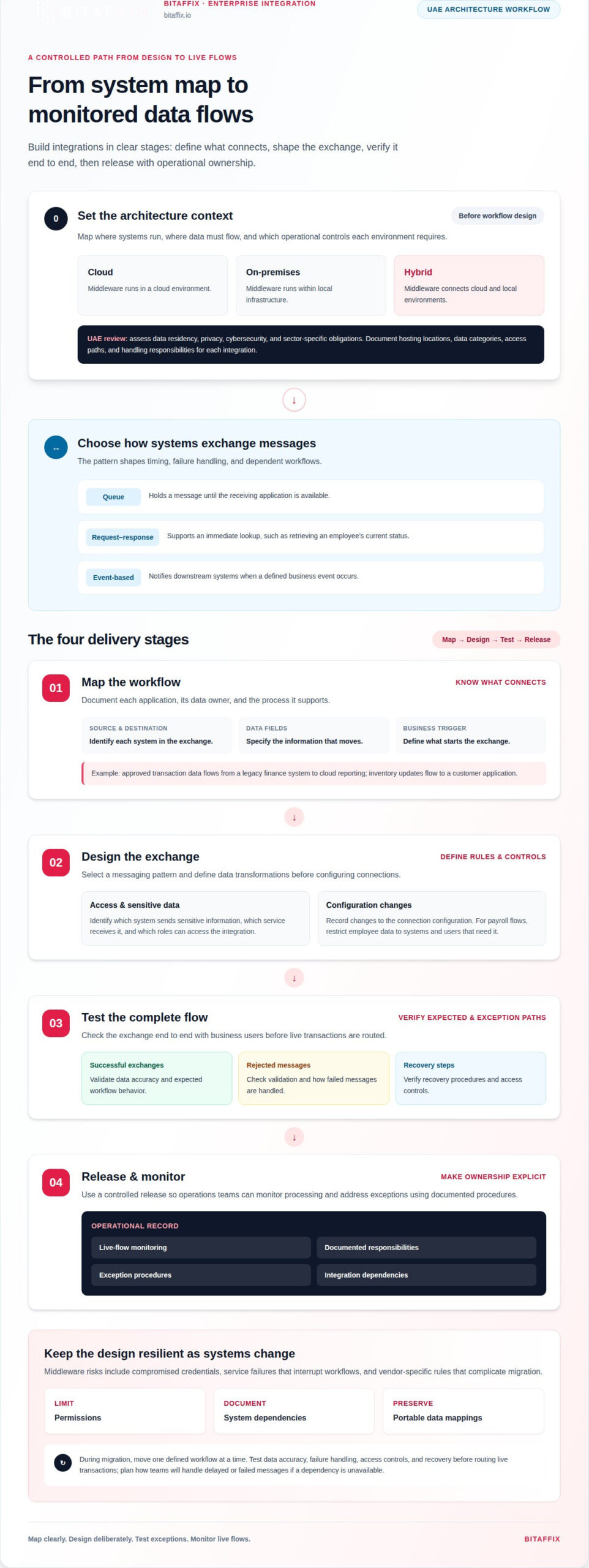
For UAE organizations, cloud middleware runs in a cloud environment, on-premises middleware runs within local infrastructure, and hybrid middleware connects both. Choose placement by mapping where systems run, where data must flow, and which operational controls each environment requires.
Integration and Application Development
Enterprise application integration connects systems that use different data formats or communication methods. For example, a legacy finance system can send approved transaction data to a cloud reporting platform, while inventory updates flow to a customer application. Before designing the integration, map each source, destination, data field, and trigger. Learn more about enterprise database integration software and how EAI connects business applications.
Enterprise applications should account for these connections from the design stage. A mobile application displaying order status, for example, needs a dependable route to the system holding current order data. Assess how middleware handles interface changes, failed messages, and data validation so application updates don’t silently disrupt connected processes.
Security and Regulatory Requirements
Enterprise application security depends on controlling each connection, not just protecting the user-facing application. Identify which system sends sensitive information, which service receives it, and which roles can access each integration. For a payroll flow, restrict employee data to the systems and users that need it, and record changes to the connection configuration.
For deployments in the UAE, assess data residency, privacy, cybersecurity, and sector-specific regulatory obligations in light of your organization’s activities and data flows. Document hosting locations, data categories, access paths, and handling responsibilities for each integration. This gives security and compliance teams a practical basis for reviewing the architecture without assuming the same rules apply to every organization.
Availability, Migration, and Vendor Lock-In Risks
Middleware brings security, availability, vendor lock-in, and migration risks that should inform the design. A compromised integration credential can expose connected systems, while a failed middleware service can interrupt several workflows. Vendor-specific connectors or transformation rules can also complicate future migration. Reduce these risks by limiting permissions, documenting dependencies, and preserving portable data mappings.
During migration, move one defined workflow at a time, such as inventory updates between a legacy system and a cloud application. Test data accuracy, failure handling, access controls, and recovery procedures before routing live transactions. Identify business-critical integrations and plan how teams will handle delayed or failed messages if a dependency becomes unavailable.
Enterprise integration middleware and iPaaS vendors
Middleware coordinates communication between enterprise applications. Integration platform as a service (iPaaS) provides integration capabilities through a cloud platform. Both can connect systems, transform data, and manage message flows. The distinction matters when deciding where integration runs, who operates it, and how it fits the existing architecture. For example, a bank may connect an on-premises transaction system with cloud-based reporting while retaining control over each data exchange.
Assess the architecture, not just the feature list. A messaging pattern determines how connected systems exchange information. A queue can hold a message until the receiving application is available, while a direct request-response flow suits an immediate lookup, such as retrieving an employee’s current status. Event-based integration can notify downstream systems when a defined business event occurs. Each pattern affects timing, failure handling, and the design of dependent workflows.
Integration delivery needs clear milestones and testing at each stage. Begin by mapping source and destination systems, data ownership, and business triggers. Then define message formats, access permissions, and failure handling. Configure the connections, test expected and rejected data, and validate end-to-end workflows with business users. A controlled release lets operations teams monitor processing and address exceptions using documented procedures.
- Map: Document each application, its data owner, and the process it supports.
- Design: Select a messaging pattern and define data transformations.
- Test: Validate successful exchanges, rejected messages, and recovery steps.
- Release: Monitor live flows and record operational responsibilities.
UAE integration priorities vary by industry. A bank may prioritize transaction traceability, while an insurer may coordinate policy and claims records. An energy organization may connect operational and finance applications; a school may link student administration with payroll or accounting. These examples call for different data models and operational controls, so architecture should follow the actual process rather than a generic template. For more on how workflows, controls, and integrations shape automation investment across sectors, see industry-specific workflow automation costs and ROI.
A scalable integration architecture separates reusable connections from individual business workflows. For example, a shared customer-data service can support several applications, while each workflow applies its own validation rules. This structure helps isolate changes as systems evolve. An integration engineer role in Abu Dhabi involving middleware solutions aligned with enterprise architecture and regulatory standards illustrates the need to coordinate technical design with organizational controls.
For UAE organizations comparing enterprise integration approaches, document deployment needs, message patterns, testing scope, and operational ownership together. That gives technology and business teams a common basis for evaluating architecture. To discuss an integration scope and delivery milestones, schedule an integration planning discussion.
Role-based access and auditability
Role-based access assigns permissions according to job responsibilities, limiting what each user or service can do. In a finance integration, an accounts employee may view payment status, while an integration administrator changes the connection. Separating these duties reduces unnecessary access and clarifies who can transform data, approve changes, or investigate failures.
Start by mapping each middleware function to the role responsible for it. Distinguish business users, platform administrators, application owners, and automated service accounts. For example, a customer-service employee might read an order status through an application but shouldn’t edit the underlying finance-to-inventory mapping. Set permissions around required actions, not broad job titles alone.
Service accounts need dedicated controls. An automated connection between a human resources system and payroll should use its own identity, with access restricted to the fields and operations it needs. Record who owns that identity, where its credentials are managed, and how administrators revoke access when a system or process changes.
- Read: View integration status or approved records without changing configurations.
- Operate: Restart a failed workflow or review its processing queue.
- Administer: Change mappings, endpoints, or connection settings.
- Audit: Review access history and configuration changes without editing them.
Auditability depends on useful records. Capture the identity behind a change, the affected integration, the time, and the action taken. If a payroll message fails after a mapping update, this trail helps the responsible team link the error to the change. Retain enough context to investigate events without exposing unnecessary personal or business data.
Review access after operational changes. When an employee moves from application support to finance, update their middleware permissions to match their new duties. When an integration owner leaves a project, reassign ownership and remove access that no longer serves a defined task. These steps reduce accumulated permissions and clarify accountability.
For organizations in the UAE, align access design with internal governance and obligations relevant to their data and sector. A bank, school, or energy company may handle different records and workflows, so tailor permissions to each integration’s purpose. Document the rationale, owner, and review process to make governance practical without imposing identical controls on every flow.
Keep the access model usable. Excessive approval steps can add operational effort and encourage workarounds, while broad permissions weaken oversight. Define an accountable approver for sensitive changes, test access with representative roles, and confirm routine tasks can be completed without administrator privileges. Review access and audit trails as part of each integration change.
Vendor selection, portfolio, and pricing
Select middleware by matching its capabilities to your integration portfolio, operating model, and governance requirements. A structured evaluation helps organizations in the UAE distinguish essential functions from features that add complexity without supporting a defined workflow.
Vendor Selection Criteria
Start with the systems and processes the platform must support. For example, an organization connecting a legacy finance system, a cloud reporting service, and a mobile application needs compatible interfaces, clear data transformation, and manageable monitoring. Assess how the vendor handles errors, system changes, and operational visibility across those connections.
Review the service portfolio against the complete operating lifecycle. Consider configuration, testing, deployment, monitoring, documentation, and ongoing ownership. A focused demonstration can make these capabilities easier to assess; a session of 30-60 minutes can provide time to examine a representative workflow, such as sending an approved invoice between finance applications.
- Compatibility: Examine support for the applications and communication patterns in scope.
- Operations: Review monitoring, exception handling, and administrator workflows.
- Governance: Assess access controls, audit records, and change management.
- Portability: Understand how integrations and data mappings can be maintained or moved.
Ask for a demonstration of the workflow your teams actually need, rather than a generic presentation. For an employee onboarding process, trace how a new record moves from a human resources system to payroll, then inspect the failure path. This reveals whether the solution supports everyday operations as well as successful data exchange.
Pricing Considerations
Middleware pricing depends on the use case and is provided after a quote request. Cost factors include the number and complexity of integrations, required data transformations, deployment model, implementation scope, monitoring needs, and ongoing operational responsibilities. A simple connection between two stable applications has different requirements from an integration portfolio spanning legacy systems and cloud services.
Separate one-time delivery activities from recurring platform or support costs in the proposal. For example, identify whether configuration, testing, migration assistance, and monitoring are included, and clarify which work remains with internal teams. This breakdown helps finance compare the full operating model, not just a headline figure.
Examine how changes in usage or infrastructure affect the commercial model. If a process adds applications, increases message traffic, or requires a new server environment, understand how those changes affect future charges. Record assumptions about volumes, integrations, and responsibilities so later scope changes have a clear reference point.
Keep selection disciplined by scoring each proposal against the same workflows, governance needs, and operating assumptions. A written evaluation makes trade-offs visible and supports a decision that balances portfolio fit, monitoring capabilities, and the overall cost structure.
Discuss your integration scope and evaluation criteria in a middleware planning conversation.
What UAE data residency, privacy, cybersecurity, and regulatory requirements apply to middleware deployments?
For enterprise middleware software UAE deployments, assess data location, privacy, cybersecurity, and sector obligations against your organization’s actual systems and information. Requirements can differ by data type, business activity, and applicable regulatory framework, so map these factors before selecting a hosting model or connecting applications.
Begin with a data-flow inventory. For each integration, record the source system, destination, data categories, hosting locations, and parties that can access the information. A payroll connection, for example, may move employee records from a human resources platform to finance software. Document where each system stores data and whether middleware copies, transforms, or temporarily retains it.
Base data residency analysis on those flows. Identify the locations of the middleware platform, connected applications, backups, and operational logs. If an organization in the UAE connects a locally hosted system to a cloud service, map each transfer and storage point. Then assess the relevant contractual, sector, and regulatory requirements for that data before deciding on the deployment architecture.
- Privacy: Identify personal data fields, their purpose, and which systems receive them.
- Access: Limit permissions to roles and service accounts that need each integration.
- Security: Review authentication, encryption, credential handling, and change controls.
- Evidence: Maintain records of data flows, access, configuration changes, and incidents.
A cybersecurity review should cover the entire integration path, not just the middleware console. For a customer record moving between a service application and a finance system, assess the credentials, interfaces, data transformations, and monitoring at each stage. Define who owns security updates and incident handling across the organization and its technology providers.
Consider sector obligations separately. A bank, insurer, energy company, or school in the UAE may process different information under different oversight expectations. Map each business process to its data and accountable owner, then have the organization’s compliance and security teams evaluate applicable requirements. Avoid assuming one deployment pattern suits every department or industry.
Before release, retain a concise architecture record covering hosting locations, data categories, access roles, safeguards, and operational responsibilities. For a document-archiving workflow, show how files enter the archive, who can retrieve them, and how access events are recorded. Revisit the record when a connected system, data flow, or business purpose changes.
Organizations without enterprise integration may face manual data entry, delayed reporting, inconsistent information, and inefficient workflows. These operational risks can undermine the accuracy and timeliness of records moving between systems. Check whether middleware controls reduce these risks and make exceptions visible to accountable owners.
Operational readiness also depends on support capacity, including staff able to troubleshoot interfaces, monitor failures, and coordinate fixes with providers. As an example of a role requirement rather than a general UAE rule, an enterprise senior application support role in Abu Dhabi required a minimum of 5 years of relevant L2 application support experience. Organizations should define equivalent responsibilities for their integration environment and ensure escalation paths cover technical incidents and compliance questions.
BitAffix: Middleware
BitAffix provides middleware for organizations connecting legacy systems, cloud platforms, and business applications. Turn to this solution when disconnected data flows create manual steps, inconsistent records, or fragmented operational workflows. Middleware integration supports coordinated information exchange across systems, while Workflow Automation structures repeatable processes. Kanban Task Automation organizes operational work, and Secure Document Archiving supports managed document storage within business processes.
To define a practical starting point, outline the systems involved, the information they exchange, and the workflow that depends on it. This gives the integration discussion a clear scope and ties architecture decisions to operational needs.
Contact BitAffix to discuss your middleware integration requirements.
Build the next stage of your integration roadmap
Make your next step a defined business outcome, not simply a technology purchase. Choose one process where connected systems can reduce handoffs, then establish its data owner, governance needs, and operational success criteria. This gives your enterprise middleware software in the UAE initiative a focused starting point and a clear basis for future expansion.
BitAffix combines middleware with Workflow Automation, Kanban Task Automation, and Secure Document Archiving to support connected operational processes. When you’re ready to shape an integration roadmap around your organization’s priorities, discuss the systems and workflows in scope.
A well-defined first integration can provide a sound foundation for broader modernization.
Frequently Asked Questions
What enterprise middleware platforms are available in the UAE?
Organizations in the UAE can evaluate cloud-based integration platforms, on-premises middleware, and hybrid architectures. The right platform depends on where applications run, how teams operate integrations, and which governance controls apply. When assessing enterprise middleware software in the UAE, consider connector compatibility, deployment options, monitoring, and how integrations can be maintained as systems change. A platform demonstration using a representative workflow can reveal practical fit better than a feature checklist alone.
Which UAE-based vendors and systems integrators provide enterprise middleware software?
BitAffix provides middleware and system integration tools that connect enterprise databases and legacy platforms. Its middleware helps organizations coordinate data exchange across existing systems and operational processes. Define the applications, workflows, and data involved before discussing a solution. This gives the integration conversation a specific focus, such as connecting a records system to an approval process, rather than treating middleware as an isolated technology purchase.
What are typical enterprise middleware licensing, subscription, and implementation costs in the UAE?
Costs depend on integration scope and the operating model, including the number and complexity of connections, data transformations, deployment choices, implementation work, and monitoring responsibilities. Licensing and subscription terms also vary by platform and usage structure. For a useful estimate, define the applications involved, expected data flows, and required delivery support. Separate initial implementation from recurring platform and operational expenses when comparing proposals.
Which UAE industries commonly use enterprise middleware, and for what use cases?
Organizations in banking, insurance, energy, education, and automotive can use middleware to connect applications supporting industry workflows. A bank may link transaction and finance systems; an insurer may coordinate policy and claims records. An energy organization can connect operational and administrative applications, while a university may link student and finance processes. Design each integration around the organization’s data, process ownership, and governance needs. For a related look at sector-specific workflow design and measurable returns, see industry-specific workflow automation costs and ROI.
How does enterprise middleware integrate with UAE government services, UAE Pass, and local payment systems?
Middleware can act as an orchestration layer between enterprise applications and external services, including government services, UAE Pass, or payment systems, when suitable interfaces and access arrangements are in place. Treat each connection as a distinct integration: define its business purpose, required data, authentication method, error handling, and responsible system owner. Also account for the service’s technical specifications and applicable approval process before designing the data flow.
How should a UAE enterprise select, procure, and implement middleware software?
Start with a documented business use case, then define system scope, data ownership, deployment needs, and operational responsibilities. During procurement, compare proposals against the same workflow and ask for a practical demonstration of its expected path and exception handling. Set acceptance criteria before implementation, including data accuracy, access governance, and support ownership. Begin rollout with a clearly bounded process, then use operational feedback to guide later integrations.