
Enterprise workflow automation software UAE organisations choose should reduce manual handoffs while preserving accountable approvals, audit trails and the flexibility teams need. Feature counts alone won’t show whether a platform fits. Operating controls and integration matter just as much.
That balance matters when processes cross departments, legacy platforms and disconnected databases. Automation can improve visibility when it works with existing systems and keeps appropriate human oversight in place. Governance and data handling also shape how organisations assess platforms across regulated and operationally complex sectors in the UAE.
This guide provides a practical framework for evaluating governance, interoperability, operational fit and business value. It explains how to assess connections to existing platforms, where automation should route decisions to people and which operational outcomes to track. It also distinguishes workflow automation, Kanban task automation, middleware and secure document archiving, so your evaluation stays focused on the needs your organisation must address.
Key Takeaways
- Evaluate enterprise workflow automation software UAE organisations can govern and integrate, rather than choosing by feature count alone.
- Distinguish workflow automation, Kanban task automation, document archiving and middleware so each capability addresses a defined operational need.
- Prioritise essential controls and weigh evaluation criteria according to process risk, governance needs and interoperability requirements.
- Start with one repeatable process, define ownership and completion evidence, then test and review outcomes before expanding.
- Map BitAffix’s separate automation, archiving, middleware and sector-specific capabilities to the requirements established in your evaluation.
Why enterprise workflow automation software matters for UAE organisations
Enterprise workflow automation coordinates the tasks, decisions, handoffs and records that move a process from initiation to completion. It gives work a defined sequence, assigns responsibility at each stage and captures evidence of progress. As described in the broader business process automation model, automation can coordinate activity across people and systems. It doesn’t mean every decision should happen without human review.
This distinction matters when teams rely on email, spreadsheets and disconnected databases to move requests forward. A handoff can stall without a clear owner. Teams may apply the same approval rules inconsistently, while managers lack a reliable view of outstanding work. These problems point to practical requirements: visible process status, defined approval authority and workflow rules, dependable records and clear exception handling, not simply more automated steps.
Which enterprise processes are suitable for automation?
Start with repeatable work that has a recognisable trigger, an accountable owner, stable decision rules and an objective completion point. Service requests, scheduled operational reviews and controlled internal approvals can be suitable when participants know what information they need and how to route routine cases.
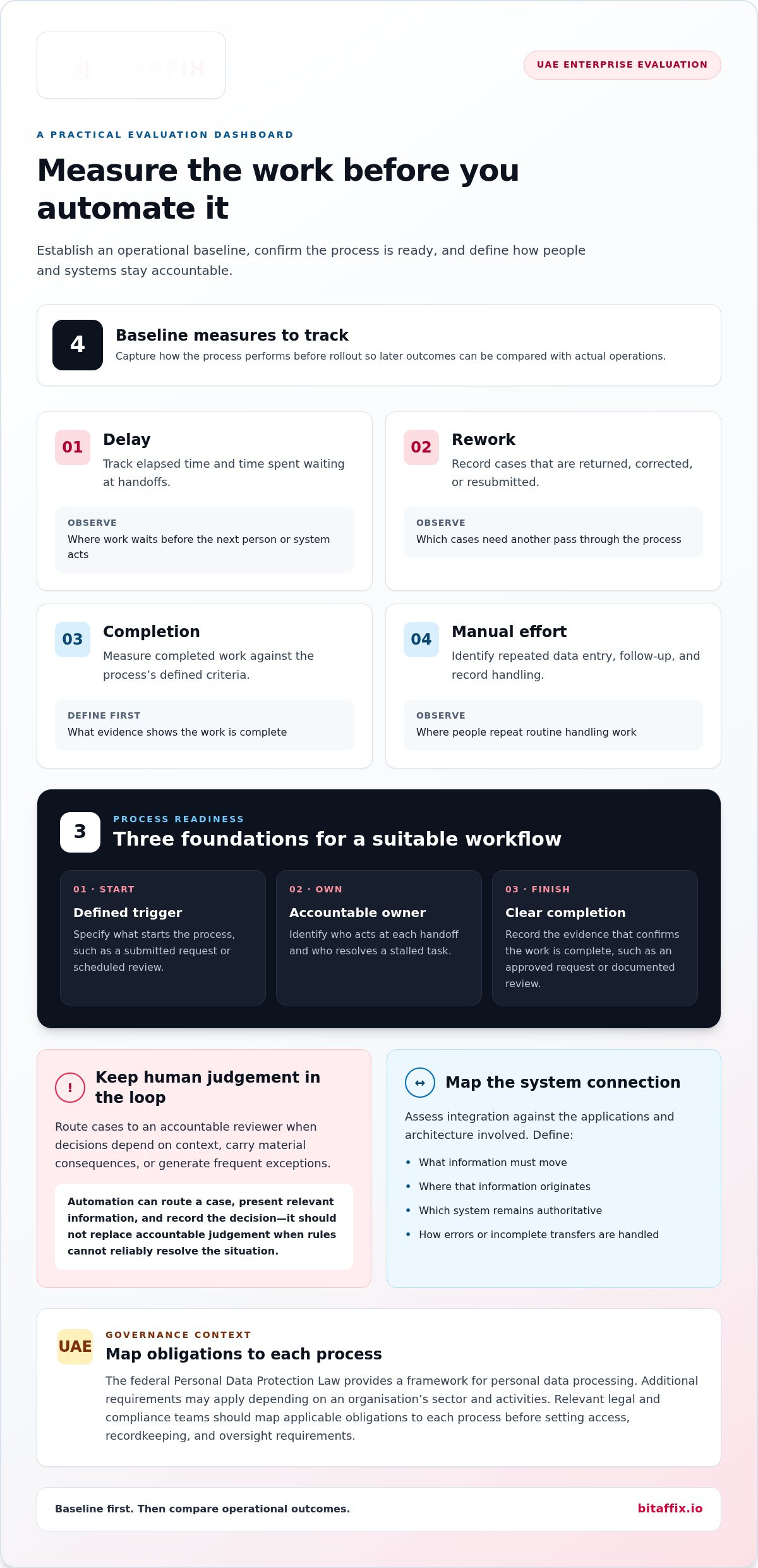
- Define the trigger: Specify what starts the process, such as a submitted request or a scheduled review.
- Assign ownership: Identify who acts at each handoff and who resolves a stalled task.
- Set completion criteria: Record what evidence shows the work is complete, such as an approved request or a documented review.
Keep people involved when decisions depend on context, carry material consequences or generate frequent exceptions. Automation can route a case, present relevant information and record the decision. It shouldn’t replace accountable judgement when rules cannot reliably resolve the situation. This boundary helps organisations improve consistency without removing appropriate control.
What should UAE buyers establish before comparing platforms?
Map the current process before assessing enterprise workflow automation software UAE options. Document the process owner, participants, handoffs, records created and systems involved. Note operational constraints such as duplicate data entry, approval bottlenecks and steps that depend on knowledge held by one person. This baseline makes requirements specific to the organisation instead of relying on a generic feature checklist.
Governance requirements depend on the organisation’s activities and regulatory context. UAE buyers should identify which data protection and sector-specific obligations apply to their entity, rather than assuming one framework covers every operation. The federal Personal Data Protection Law provides a framework for personal data processing, while additional requirements may apply depending on the organisation’s sector and activities. The relevant legal and compliance teams should map applicable obligations to each process before setting access, recordkeeping and oversight requirements.
Establish baseline measures before a rollout so you can assess value against actual operations:
- Delay: Track elapsed time and time spent waiting at handoffs.
- Rework: Record returned, corrected or resubmitted cases.
- Completion: Measure completed work against the process’s defined criteria.
- Manual effort: Identify repeated data entry, follow-up and record handling.
These measures give decision-makers a defensible starting point. They help distinguish a genuine operational improvement from a process that has simply moved into new software.
How enterprise workflow automation software fits into the wider technology environment
Workflow automation should coordinate an organisation’s existing technology environment, not assume every system needs replacing. For buyers assessing enterprise workflow automation software UAE options, the key architectural question is how work moves between people, rules, records and established platforms. A workflow can direct activity while core business systems continue to hold data and perform the functions they already manage.
Enterprise interoperability means people and systems can exchange the right information at the right process step, so work advances without duplicate entry or conflicting status records. APIs and database connections can support that exchange, depending on the systems involved and the organisation’s architecture. Define what information must move, where it originates, which system remains authoritative, and how errors or incomplete transfers should be handled. Assess integration requirements against the specific applications and architecture involved.
How workflows coordinate people, rules, and enterprise systems
Consider an operational request that begins in a business system. A workflow can receive the trigger, assign a task to the appropriate person, route routine decisions according to established rules and capture supporting evidence. If a consequential decision or exception arises, it can direct the case to an accountable reviewer. Once the process reaches its completion criteria, the final status can be recorded in the relevant system, subject to the data exchange design.
This orchestration can reduce repeated entry and separate status updates when a process otherwise moves through email, spreadsheets and legacy platforms. It also makes handoffs visible: teams can see which step is active and who is responsible. The workflow coordinates execution; it doesn’t automatically replace the systems that store operational data or the people responsible for material decisions.
When middleware and secure archiving belong in the evaluation
These capabilities address different needs. Treat them as distinct requirements rather than assuming one automatically includes another:
- Workflow automation coordinates process stages, approvals, service-level agreements and audit trails.
- Kanban task automation organises and tracks task progress through defined stages.
- Middleware supports communication and data transfer between enterprise databases and legacy platforms. Assess it when information must move between systems as part of a process.
- Secure document archiving structures records and supports access controls, governance and searchability. Assess it when records need controlled preservation and retrieval.
For example, an approval workflow may route a request and record its decision, while middleware handles required data transfer between systems. An archive may preserve related documents for governed access. Each layer has a distinct function and should have a clear role in the target architecture.
BitAffix offers workflow automation, Kanban task automation, middleware and secure document archiving as distinct capabilities. Organisations defining how these layers should work together can explore BitAffix enterprise workflow capabilities as part of their architecture review.
How to compare enterprise workflow automation software without overbuying
Compare platforms against the process and controls your organisation needs, not the length of a feature list. For enterprise workflow automation software UAE buyers, a defensible evaluation separates mandatory requirements from preferences, then gives greater weight to criteria tied to operational or governance risk.
Start by defining the outcomes the software must support. A workflow platform coordinates stages, decisions and records across a process. A task board helps teams organise and track work. Robotic process automation (RPA) automates repetitive actions through user interfaces. These tools solve different problems: a task board alone may not enforce approval authority, and RPA doesn’t by itself define end-to-end process governance.
Which governance and operational controls should buyers assess?
Test controls against realistic scenarios, including a routine approval, a reassignment and an exception. Confirm that roles and access boundaries align with responsibilities, approval authority is clear, and process owners can identify who acted and what evidence remains. Check how the platform represents escalation paths and cases that fall outside standard rules.
Automation needn’t weaken oversight. It can standardise routing while retaining human review at defined decision points. Ask for evidence behind claims about security, compliance, auditability and scale. Record what the evidence demonstrates, what it doesn’t, and which requirements need a separate control.
How to test interoperability and sector fit
Document required connections to databases and legacy platforms, then compare them with documented technical requirements. Test a representative process using realistic inputs and expected outcomes. For sector fit, use scenarios relevant to your operations, such as a controlled banking approval, an insurance case, an energy operations review, an automotive service process or an education administration workflow.
Use a weighted matrix to keep decisions traceable. Mark requirements as mandatory or desirable, and give greater weight to criteria where failure would create material operational or governance risk. The UAE compliance column should reflect obligations verified for your organisation and sector, not assumed rules applied uniformly.
| Criterion | Evaluation focus | Evidence and limitations to record | UAE compliance consideration |
|---|---|---|---|
| Process fit | Can it represent the required stages, ownership, exceptions and approval points? | Test a representative process; note gaps in routing or exception handling. | Record relevant internal controls and sector obligations identified by your organisation. |
| Governance | Can roles, access boundaries, review authority and retained records support oversight? | Review a permissions and audit scenario; distinguish demonstrated controls from claims. | Map applicable data protection and sector requirements with the responsible compliance team. |
| Interoperability | Can required data move between identified systems under documented conditions? | Test the specified exchange; list dependencies, constraints and unresolved needs. | Include any organisation-specific rules for handling or transferring relevant data. |
| Usability | Can participants complete tasks and handle exceptions within their roles? | Observe users completing the scenario; document friction and training needs. | Account for internal approval and recordkeeping procedures. |
| Reporting | Can owners review status, exceptions and completion evidence? | Compare available outputs with the measures the process owner needs. | Confirm that reporting supports applicable oversight and evidence requirements. |
Keep the matrix proportionate. BitAffix’s workflow automation, Kanban task automation, middleware and secure document archiving address distinct enterprise needs, so evaluate each against relevant criteria instead of assuming one capability covers all. This approach helps teams assess BitAffix enterprise capabilities within a broader, evidence-led comparison.
How to build a defensible evaluation and rollout plan
A controlled rollout turns a platform decision into an evidence-led operational decision. For enterprise workflow automation software UAE organisations, define the process boundary, ownership, data access and applicable governance requirements before configuring automation. Start with a repeatable process that has a clear owner and observable completion evidence. Expand only when the pilot demonstrates value without weakening control.
Use this sequence to keep evaluation, testing and rollout connected:
- Select one bounded process. Choose a recurring workflow with a manageable scope, understood participants and a clear start and finish. Exclude adjacent processes until the pilot produces evidence for expansion.
- Document requirements and constraints. Map process stages, decision rights, exceptions, data access, connected systems and records. Assign operational, IT and governance owners, and identify requirements that apply to the organisation and its sector in the UAE.
- Set success measures. Record a baseline for completion, rework, waiting time and human effort before the pilot begins. Define how each measure will be captured and who will review it.
- Test representative scenarios. Run routine cases and exceptions through the proposed workflow. Include human review at consequential decision points, and examine handoffs, access boundaries, evidence capture and system data exchanges.
- Review outcomes before expanding. Compare results with the baseline and document process, governance and integration findings. Decide whether to refine, extend or stop the rollout based on evidence, not on the number of automated tasks.
What should an enterprise workflow pilot prove?
A pilot should show that the process reaches its defined completion state, handles exceptions appropriately and preserves accountable review. Measure operational outcomes alongside control performance: completion and rework, waiting and manual effort, and whether required records and approvals are available. Record limitations and unresolved dependencies before broadening the scope.
How to prepare teams and governance for adoption
Assign process ownership and decision rights before configuring automated responsibilities. Give users concise guidance on task handling and exceptions, supervisors direction on oversight, and administrators clear procedures for managing changes. Define who reviews process updates, incidents and evolving requirements, and how teams document those decisions.
Keep the rollout proportionate. Limit initial access to what the pilot requires, agree how relevant data will be handled, and involve appropriate compliance stakeholders when assessing UAE obligations. This makes governance part of delivery rather than a late-stage review, while giving teams a practical route to resolve issues and maintain clear accountability.
BitAffix’s workflow automation supports operational processes, approval chains, service-level agreements and audit trails. Explore BitAffix workflow automation as you shape a controlled evaluation around your process requirements.
How BitAffix supports enterprise workflow automation in the UAE
BitAffix’s capabilities address distinct evaluation needs: coordinating processes, organising tasks, connecting systems and governing records. For organisations assessing enterprise workflow automation software UAE options, this provides a practical way to relate capabilities to the operating model instead of treating every requirement as one feature set.
BitAffix supports enterprise needs for governed process coordination, visible task management, structured data exchange and controlled document records.
Match BitAffix capabilities to enterprise requirements
Start with the operational requirement. BitAffix workflow automation supports processes, approval chains, service-level agreements and audit trails. Assess how these capabilities align with process ownership, decision authority, evidence needs and oversight expectations. Kanban task automation serves a different purpose: it helps structure task visibility and coordination so teams can track work as it moves through defined stages.
Other capabilities address separate parts of the enterprise environment:
- Workflow automation: Coordinates process stages, approvals and operational records.
- Kanban task automation: Organises task progress and team coordination.
- Middleware: Supports communication and data transfer between enterprise databases and legacy platforms. Assess it where system handoffs are a defined requirement.
- Secure document archiving: Provides structured records, access controls, governance and searchability for document-management needs.
Evaluate these capabilities against their own requirements rather than assuming they form a single bundled solution. For example, an organisation may assess workflow automation for approval routing, middleware for data exchange and archiving for governed records. The relevant combination depends on the process scope and target architecture.
Connect sector context to the evaluation
Sector operations shape process requirements, but sector relevance should not be treated as a blanket compliance claim. BitAffix provides industry-specific process solutions for banking, insurance, energy, automotive, and schools and universities. Use a representative operational scenario from your sector to assess process fit, required controls, records and integration needs, then map applicable governance obligations with your organisation’s responsible teams.
Keep the evaluation grounded in evidence. Define the process to be supported, identify who owns decisions and approvals, list required system connections, and specify what records the process must retain. Then assess the appropriate BitAffix capability against those criteria. This links the platform choice to operational fit and measurable outcomes, while keeping integration and document governance distinct from workflow orchestration.
Move from evaluation criteria to a practical next step
Prepare a concise decision brief covering the process boundary and owner, required governance controls, integration needs, records requirements, sector context and measures for assessing results. This gives stakeholders a shared basis for evaluating capabilities and keeps scope aligned with the operational problem.
Explore BitAffix enterprise software solutions to assess how its workflow automation, Kanban task automation, middleware, secure document archiving and sector-specific process solutions align with your organisation’s requirements.
Set the standard for your next automation decision
Make the first evaluation useful beyond a single project. Capture the principles behind your decision so future initiatives can follow a consistent path, while accounting for each process’s distinct risks and operating needs. This gives business, technology and governance teams a shared basis for deciding where automation belongs and where human judgement must remain central.
For organisations assessing enterprise workflow automation software UAE options, turn evaluation findings into a decision brief that leaders can revisit as priorities change. Focus on accountable execution and evidence of value, not automation for its own sake. This creates room to modernise operations with clarity and control.
Explore BitAffix enterprise workflow automation solutions to take the next step towards a more deliberate automation strategy.
Frequently Asked Questions
How much does enterprise workflow automation software cost in the UAE?
Costs vary according to licensing structure, user scope, selected capabilities, integration requirements and implementation effort. For an enterprise workflow automation software UAE comparison, ask vendors to scope the same documented process and state what each proposal includes. Compare ongoing administration and support needs as well as initial project scope. A low headline figure may cover a narrower set of requirements, so assess proposals against the same operational and governance criteria.
How long does an enterprise workflow automation implementation take?
Implementation time depends on process complexity, stakeholder availability, data access, integrations and governance decisions. A focused workflow, such as routing a defined internal request, is generally easier to scope than a programme spanning several departments and systems. Set project-specific milestones for requirements, configuration, testing, user preparation and outcome review. Track decisions and dependencies at each stage, and avoid treating a general estimate as a commitment for a different project.
Does enterprise workflow automation software need to be hosted in the UAE?
Not in every case; hosting decisions depend on organisational policy, contractual obligations, data classification and applicable sector requirements. Before procurement, document which information the workflow handles, who can access it and any location constraints your organisation must meet. Ask security, legal and technology stakeholders to assess those requirements, then compare them with the platform’s documented architecture. A hosting choice should follow the organisation’s verified needs, not a blanket assumption.
Is low-code workflow automation suitable for every enterprise process?
No. Low-code may suit structured processes, but the right approach depends on complexity, oversight requirements, integrations and how often rules change. For example, a standard request with defined routing may be easier to manage than a case involving unusual evidence and discretionary decisions. Assess how a platform handles permissions, process changes and exceptions. Choose according to the operating requirement, not the “low-code” label alone.
Will workflow automation eliminate the need for human review?
No. Automation can manage predictable steps while people retain responsibility for decisions that need judgement or exception handling. For example, a workflow might route a complete request automatically but refer missing information or a disputed approval to an authorised reviewer. Before launch, document which actions proceed under set rules, where review is mandatory and who owns exceptions. This keeps accountability visible as routine work moves through the process.
What should executives include in a workflow automation business case?
Include the business problem, current process evidence, intended outcomes, governance needs, project scope and accountable owners. Select measures that fit the process, such as time to complete a case, corrections required, time waiting for approval and staff effort. Also record dependencies, including data access, integration work and user adoption. After implementation, compare observed results with the baseline and business priorities, rather than relying only on projected benefits.